

Condo homeowners insurance is fundamentally different from traditional homeowners coverage, and most condo owners don’t realize the gaps until it’s too late.
Your HOA’s master policy covers the building structure, but it leaves your personal belongings, unit improvements, and liability exposure unprotected. We at Stonebrook Insurance help condo owners understand exactly what they need to cover.
How Your Condo Insurance Differs from Standard Home Coverage
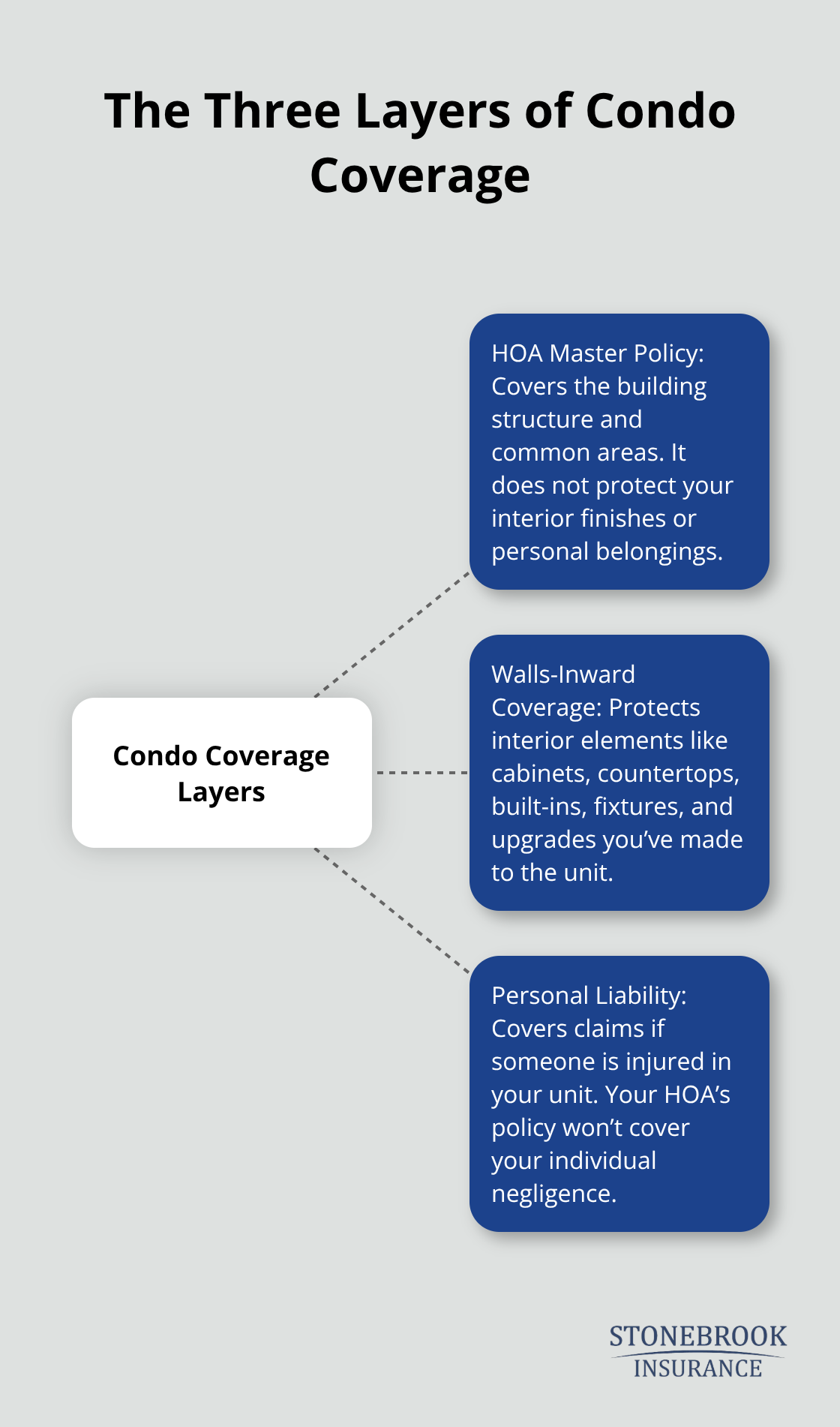
The Master Policy Only Protects the Building Structure
Your HOA’s master policy covers only the building’s structure and common areas. The roof, exterior walls, hallways, and shared amenities fall under that umbrella. However, anything inside your unit-from flooring to fixtures to your personal belongings-remains your responsibility. Condo owners frequently discover this gap after water damage or theft occurs, only to find their master policy provides zero coverage for their losses. Your HOA’s insurance protects the building investment, not your investment within it.
Understanding the Three-Layer Coverage System
Condo insurance operates on a three-layer system: the HOA’s master policy, your walls-inward coverage, and your personal liability protection. Most condo owners assume their unit is covered under the master policy, but that assumption costs them thousands in uninsured losses annually. Your walls-inward coverage must include everything from the interior walls outward-cabinets, countertops, built-in shelving, and any upgrades you’ve made.
Why Your Personal Liability Matters
Liability protection matters equally since you’re liable if someone injures themselves in your unit, and your HOA’s master policy won’t cover your individual negligence. A visitor slips on your kitchen floor, or a guest suffers an injury in your bedroom-your personal liability coverage protects you from those claims. Without adequate limits, a single incident could expose your personal assets to significant financial risk.
Upgrades and Improvements Need Separate Coverage
If you’ve made improvements beyond the builder’s standards, those upgrades receive zero protection under the master policy. A kitchen renovation, new flooring, or custom closets all require separate coverage under your individual policy. These enhancements (which can represent substantial investments) fall outside the HOA’s responsibility and must be specifically listed on your condo insurance.
What Happens When Coverage Gaps Exist
The distinction between what the master policy covers and what your individual policy must cover determines whether you’re protected or exposed. Condo owners who fail to structure their coverage properly face significant financial consequences when incidents occur. Understanding these three layers allows you to identify exactly what gaps exist in your current protection-and that’s where the real work of selecting the right coverage begins.
Selecting the Right Coverage for Your Condo
Inventory Your Personal Belongings at Replacement Cost
Start with a room-by-room inventory of everything inside your unit. Most condo owners dramatically underestimate the replacement cost of their personal belongings, and the average condo owner is underinsured by 20-30% on personal property alone. Photograph or video-record your furniture, electronics, clothing, kitchenware, and valuables, then price replacements at today’s costs, not what you paid years ago.
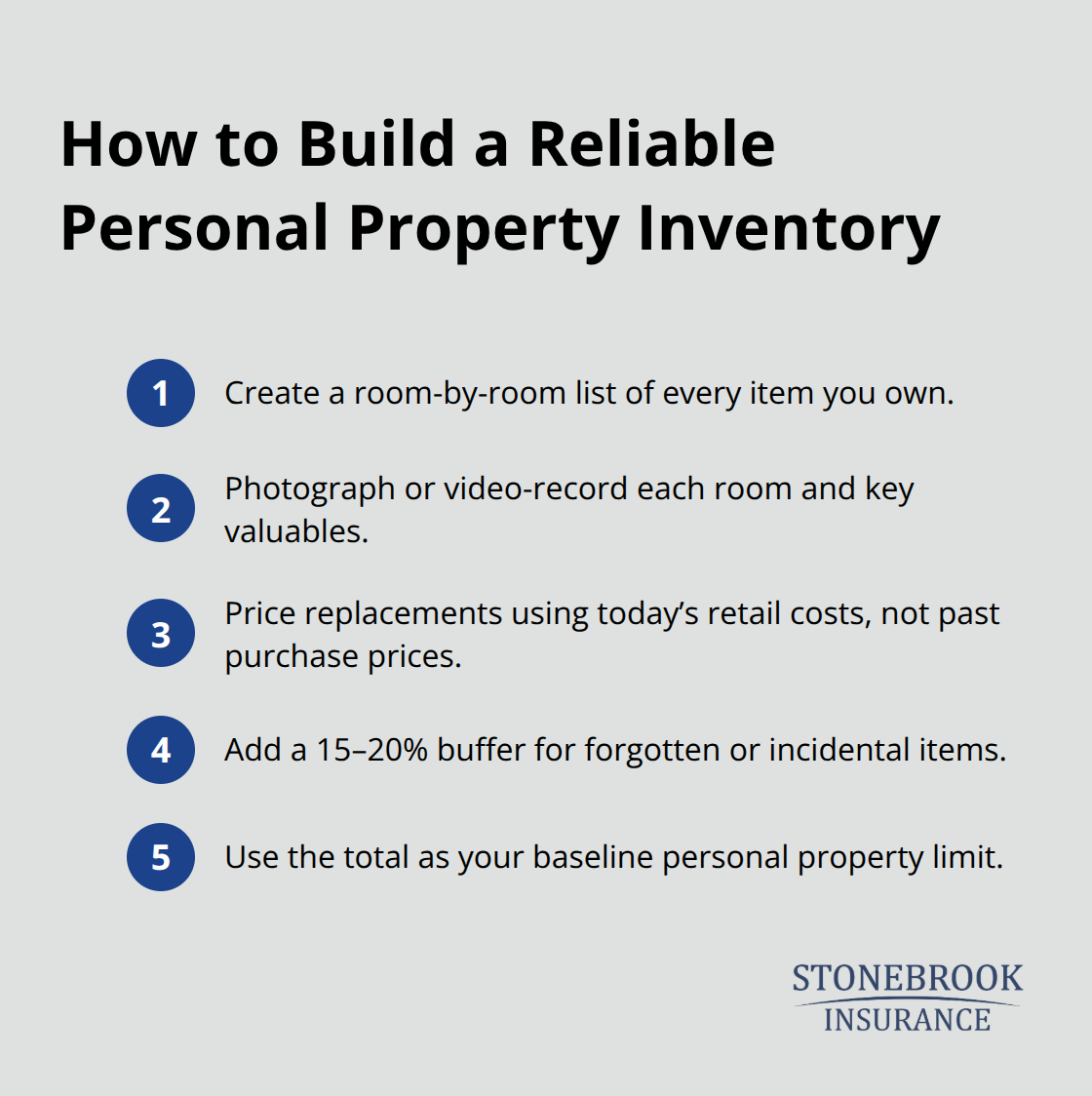
A used couch costs far more to replace than most people think, and electronics prices have climbed significantly. Once you have a realistic number, add 15-20% as a buffer for items you’ve forgotten. This inventory becomes your baseline for personal property coverage, and it’s non-negotiable if you want actual protection when loss occurs.
Request and Review Your HOA’s Master Policy Document
Contact your HOA’s management office and request the master policy document directly. Read the declaration page carefully to identify exactly which building components the policy covers. Most policies exclude interior finishes, flooring, cabinetry, and anything you’ve upgraded, leaving those gaps for your individual policy to fill.
Many HOAs also carry limited liability coverage, which means your individual liability protection fills a gap that the master policy simply doesn’t address. Ask your HOA management company three specific questions: what is the master policy’s deductible, what does it cover inside individual units, and what are the liability limits. This conversation takes 15 minutes and prevents thousands in surprise gaps. Your condo association should provide this information without delay, and if they resist, that’s a warning sign about how that HOA manages finances.
Compare Quotes Across Multiple Carriers
Contact at least three insurance carriers for quotes on the same coverage levels, not different levels. Price variation for identical HO-6 coverage typically ranges from 15-40% depending on the carrier and their underwriting practices. Request quotes that specify your walls-inward coverage amount, personal property limits, liability protection (typically $300,000 minimum for condo owners), and medical payments coverage.
Ask each carrier about discounts for bundling with auto insurance, which typically saves 10-25% on your condo policy. Shopping multiple carriers reveals significant savings that single-carrier shopping misses entirely. Once you’ve gathered these quotes and understand what your HOA’s master policy actually covers, you’re ready to identify the specific gaps that leave most condo owners exposed-and that’s where the real protection problems emerge.
Where Your Condo Coverage Actually Falls Short
Personal Property Coverage Leaves You Significantly Underinsured
Most condo owners carry personal property coverage limits that fall 20-30% below their actual replacement needs, according to insurance industry data on claims patterns. This gap exists because people estimate replacement costs from memory rather than from actual retail prices, and memory consistently fails. A kitchen full of appliances, cookware, and small electronics easily exceeds $15,000 in replacement value, yet most condo owners carry only $10,000 in personal property coverage. When theft or water damage strikes, that $5,000 shortfall comes directly out of your pocket.
The problem compounds when you factor in bedroom furniture, electronics, clothing, and bathroom fixtures. A single bedroom set runs $3,000-$5,000 at retail prices, and most people own multiple sets of quality furniture. Your actual replacement cost likely exceeds what your current policy covers, which means a total loss leaves you financially exposed.
Upgrades and Improvements Receive No Protection
The second major gap involves upgrades and improvements that you’ve paid for but never listed on your policy. A $25,000 kitchen renovation, new hardwood flooring, or custom closets represent substantial investments that fall outside the HOA’s master policy and outside standard condo coverage unless you specifically add them. Most condo owners simply assume their base policy covers these improvements, then learn otherwise during the claims process.
Your builder’s standard finishes receive no coverage under the master policy, and your upgrades receive no coverage under a standard condo policy. That distinction matters enormously when water damage or fire affects your unit. You must specifically list each major improvement with its replacement cost on your individual policy to protect that investment.
Liability Limits Fall Far Short of Actual Risk
Standard condo policies often include only $100,000 or $150,000 in liability protection, but a single serious injury in your unit can generate medical bills, legal fees, and damages exceeding $500,000. Insurance companies see this liability gap constantly in condo claims, and the financial consequences for underinsured owners are severe. A visitor slips on your floor, a guest suffers a fall, or someone experiences an allergic reaction in your unit-any of these incidents can trigger claims that exhaust inadequate liability limits within days.
Your personal assets face direct exposure when liability claims exceed your policy limits. A judgment against you can attach to your bank accounts, investment accounts, and future income, making this gap one of the most dangerous in condo coverage.
Three Actions That Eliminate These Gaps
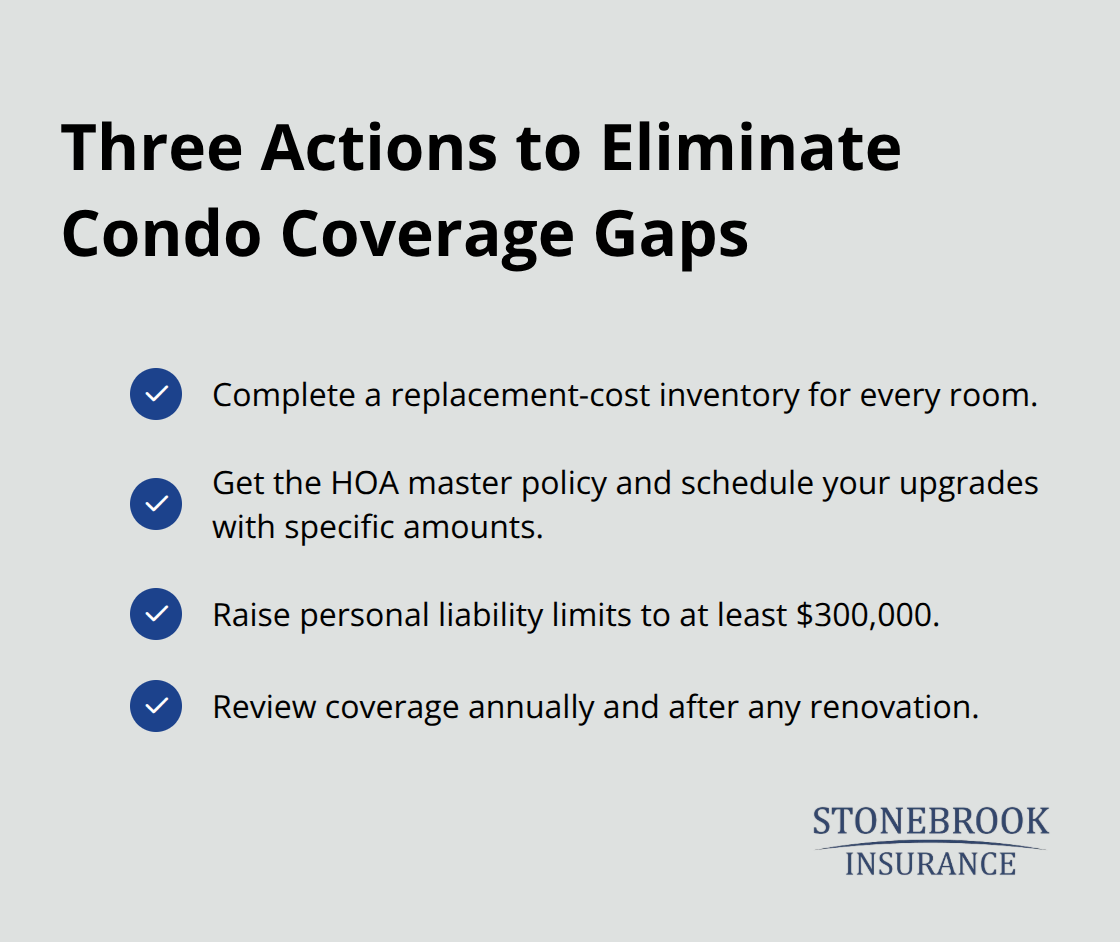
First, conduct an actual replacement cost inventory by visiting retailers and pricing what your belongings would cost new, not what you paid for them years ago. Photograph or video-record each room, then price replacements at current retail rates. This inventory takes a few hours but reveals the true value you need to protect.
Second, contact your HOA and request the master policy document, then identify every interior component or upgrade you’ve made that isn’t listed in that document. Add those items to your individual policy with specific coverage amounts. Third, increase your liability limits to a minimum of $300,000, which costs only $15-30 more per year than inadequate limits and protects your actual financial exposure.
Final Thoughts
Condo homeowners insurance protects what your HOA’s master policy leaves exposed, and that distinction determines whether you face financial security or devastating losses. The three gaps we covered-underinsured personal property, unprotected upgrades, and inadequate liability limits-affect nearly every condo owner who hasn’t specifically addressed them. Your master policy covers the building structure, but your individual policy must cover everything inside your walls, every improvement you’ve made, and your personal liability exposure.
Complete an actual replacement cost inventory by visiting retailers and pricing what your belongings would cost new today. Obtain your HOA’s master policy document and identify every interior component or upgrade not listed there, then add those items to your individual policy with specific coverage amounts. Increase your liability limits to at least $300,000, which costs minimal additional premium but protects your actual financial exposure.
We at Stonebrook Insurance help Texas families and individuals secure the right condo homeowners insurance for their specific situations. Contact Stonebrook Insurance today for a personalized quote that addresses your actual coverage needs and protects your investment completely.
The information provided in this blog is for general informational purposes only and does not constitute legal, financial, or insurance advice. Coverage options, terms, and availability may vary. Please consult with a licensed professional for advice specific to your situation.
Artificial intelligence may have been used to generate text and images in some blog articles.