
Construction projects in Texas face real risks-from weather damage to theft to liability claims. Builder risk insurance protects your investment during every phase of building, covering structures, materials, equipment, and legal exposure.
We at Stonebrook Insurance work with Texas builders to find policies that match their specific project needs. This guide walks you through what builder risk insurance covers, why it matters, and how to select the right protection for your next project.
What Builder Risk Insurance Actually Protects
Builder risk insurance covers three distinct layers of exposure on Texas construction sites, and understanding each one prevents costly coverage gaps. The policy protects the structure itself during construction, including framing, roofing, electrical systems, and permanent fixtures installed on-site. If a windstorm damages the roof before closing or a fire destroys interior walls mid-project, your policy covers the cost to repair or replace those components. Texas builders face particular weather exposure-hail, lightning, and wind damage account for significant construction losses across the state.
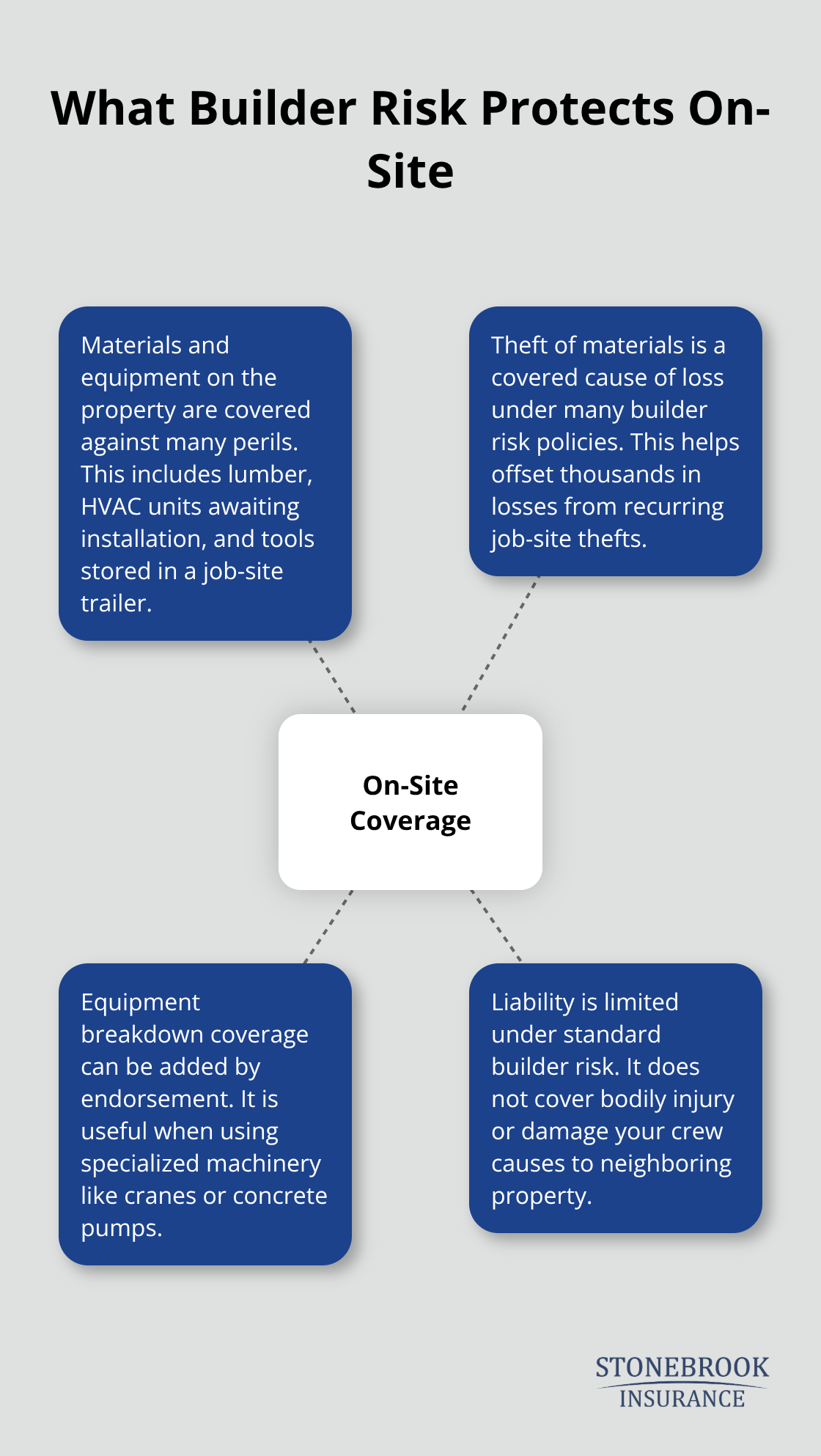
The policy also covers materials and equipment staged on the property, whether lumber stacked in the yard, HVAC units awaiting installation, or tools stored in a job-site trailer. Theft of materials represents a real problem on Texas construction sites; material theft costs builders thousands annually, and builder risk policies protect against this loss. Equipment breakdown coverage can be added if you use specialized machinery like cranes or concrete pumps. However, liability protection under a standard builder risk policy is limited-it does not cover bodily injury claims if someone is injured on-site or property damage caused by your crew to neighboring properties.
What Builder Risk Does Not Cover
Builder risk is all-risk property coverage, meaning it protects against most perils unless specifically excluded, such as nuclear incidents or acts of war. That’s where general liability and workers’ compensation must sit alongside your builder risk policy as part of a complete risk strategy.
The Exclusions That Matter Most
Not everything is covered under builder risk, and missing these gaps can leave you exposed. Flood damage is excluded from standard builder risk policies in most states, including Texas, which means you need separate flood coverage through the National Flood Insurance Program or private flood insurance if your project sits in a designated flood zone. Windstorm coverage also carries restrictions in coastal and high-wind areas of Texas, sometimes with higher deductibles or separate windstorm policies required.
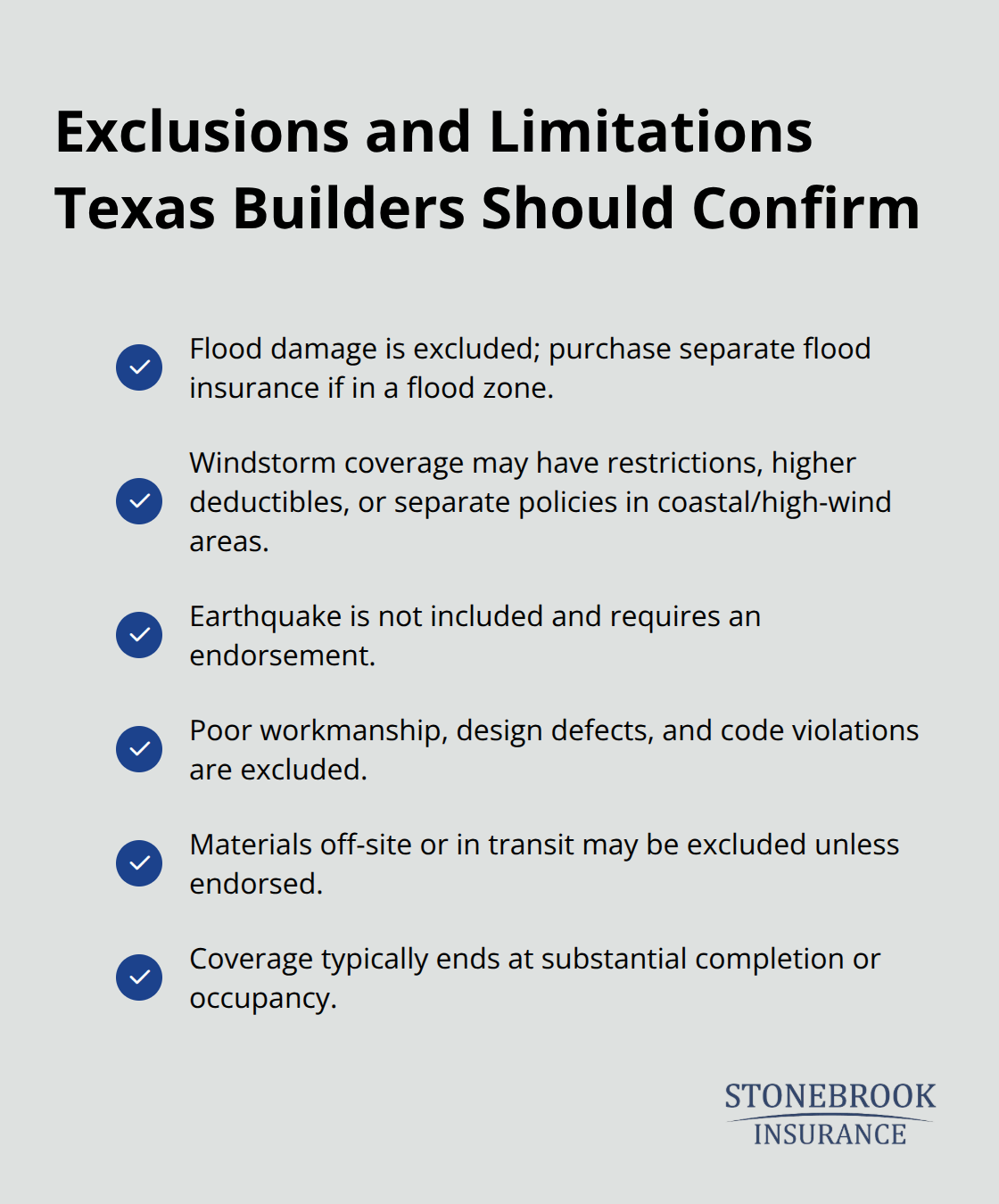
Earthquake coverage is never included and must be added as an endorsement if your project is in an area with seismic risk. Loss or damage caused by poor workmanship, design defects, or failure to follow building codes is excluded-the policy doesn’t cover your own mistakes. Materials left unattended off-site or in transit may not be covered unless specifically endorsed, so staging materials at a supplier’s yard or leaving equipment at a vendor facility creates a coverage question you need to clarify with your agent.
Unfinished work also has time limits; once construction is substantially complete or occupancy begins, builder risk terminates and homeowners insurance takes over. This transition point matters because a gap between policies leaves you vulnerable.
Tailoring Coverage Limits and Deductibles
The coverage limits and deductibles you choose directly impact your premiums and your financial exposure. Most Texas builders select coverage limits equal to the total project cost, including labor, materials, and overhead, to avoid being underinsured. Your deductible-typically ranging from $1,000 to $25,000-determines how much you pay out-of-pocket before the insurer covers a loss. Larger deductibles lower premiums but increase your risk if a loss occurs.
Adding Endorsements for Specialized Work
Endorsements allow you to tailor the policy to your specific project type, whether you’re building single-family homes, multi-unit residential, or commercial properties. If your project involves specialized work like pool installation or solar panel setup, those require separate coverage or endorsements because standard builder risk doesn’t automatically include them. Coverage period matters too-the policy runs from the start of construction through project completion or occupancy, whichever comes first. If your project extends beyond the initial estimate, you need to notify your insurer and potentially adjust the policy term to avoid a lapse in coverage.
The right policy structure depends on your project’s unique risks and timeline. Understanding what your builder risk policy covers-and what it doesn’t-positions you to make informed decisions about additional coverage. Your next step involves assessing your specific project scope and determining which coverage options align with your construction timeline and budget constraints.
Why Texas Builders Face Real Builder Risk Exposure
Weather Creates Outsized Risk in Texas
Builder risk insurance isn’t optional for Texas builders-it’s a financial necessity shaped by state-specific hazards, lender demands, and the brutal economics of construction losses. Texas weather creates outsized risk compared to most states. Hail damage alone costs Texas builders millions annually, with the state experiencing frequent severe hail events that destroy roofing, siding, and window installations mid-project. Windstorms and lightning strikes add to this exposure, particularly in north and central Texas where spring storms pack destructive force. A single hail event delays a project by weeks, driving up labor costs and overhead while materials sit damaged on-site. Without builder risk insurance, you absorb these losses directly, which means a bad weather event wipes out profit margins on multiple projects simultaneously.
Lenders Require Builder Risk as a Condition of Financing
Lenders and construction loan underwriters mandate builder risk coverage as a condition of financing, which means you cannot access construction capital without proof of an active policy. Banks view builder risk as non-negotiable protection for their interest in the project, and they require the policy to name them as loss payee. This isn’t a suggestion-it’s a contractual requirement in virtually every construction loan agreement in Texas. Your lender won’t fund the project without this protection in place, making builder risk a prerequisite to starting work.
Material Theft Drains Profit on Texas Job Sites
Material theft on Texas construction sites creates a constant financial drain that compounds across your portfolio. Copper wiring, HVAC equipment, and finished materials disappear from job sites regularly, and builder risk policies cover these losses so you don’t absorb the cost. A single theft represents thousands in lost materials, and repeated thefts across multiple projects multiply the damage. Builder risk coverage protects your bottom line against this predictable but preventable loss category.
Project Delays Extend Your Carrying Costs
Project delays caused by weather, permitting issues, or site conditions extend your carrying costs-interest on construction loans, temporary utilities, and labor overhead all continue accruing while work stops. Builder risk policies can include coverage for these soft costs when delays occur, protecting your cash flow during inevitable project interruptions. This coverage matters because delays don’t stop your expenses; they only stop your progress. The financial pressure of extended carrying costs can strain liquidity faster than material losses alone.
Multiple Sites Multiply Your Exposure
Texas builders operating multiple sites face multiplied exposure because a weather event or supply chain disruption affects several projects at once. The concentration of residential construction in Texas growth corridors means many builders deploy significant capital across multiple simultaneous builds, amplifying the financial impact of any single loss event. Without builder risk insurance, a major loss doesn’t just affect one project-it cascades across your entire operation, potentially straining liquidity and threatening your ability to start new projects. This portfolio-level risk makes builder risk insurance not just a project-by-project decision but a business continuity requirement.
Understanding these Texas-specific exposures shapes how you structure your builder risk coverage and what limits you need to protect your operation. The next step involves identifying which coverage options align with your project scope and determining how to work with an insurance agent to customize a policy that addresses these real hazards.
How to Choose the Right Builder Risk Policy
Calculate your total project cost with precision
Start by calculating your total project cost with precision, because underestimating this number creates catastrophic coverage gaps. Your coverage limit should equal the full construction cost, including labor, materials, subcontractor fees, equipment rentals, permits, and overhead-not just the hard costs of materials and structure. Many Texas builders make the mistake of insuring only the building itself, forgetting that staged materials, tools, temporary structures, and soft costs represent real exposure that needs protection. If your project totals $500,000 but you only insure $350,000, a major loss leaves you personally liable for the $150,000 shortfall.
Calculate this figure carefully because underinsurance forces you to absorb losses out-of-pocket, which destroys profitability faster than any single construction mishap. Verify your numbers with your lender, since construction loan documents specify the minimum coverage amount required before funding releases.
Select a Deductible That Matches Your Cash Position
Your deductible choice directly controls your premium cost and your financial exposure during a loss event. A $2,500 deductible costs significantly less than a $1,000 deductible, but it means you pay $2,500 out-of-pocket before the insurer covers anything. Texas builders typically select deductibles between $2,500 and $5,000 because this range balances affordable premiums against manageable out-of-pocket costs when losses occur.
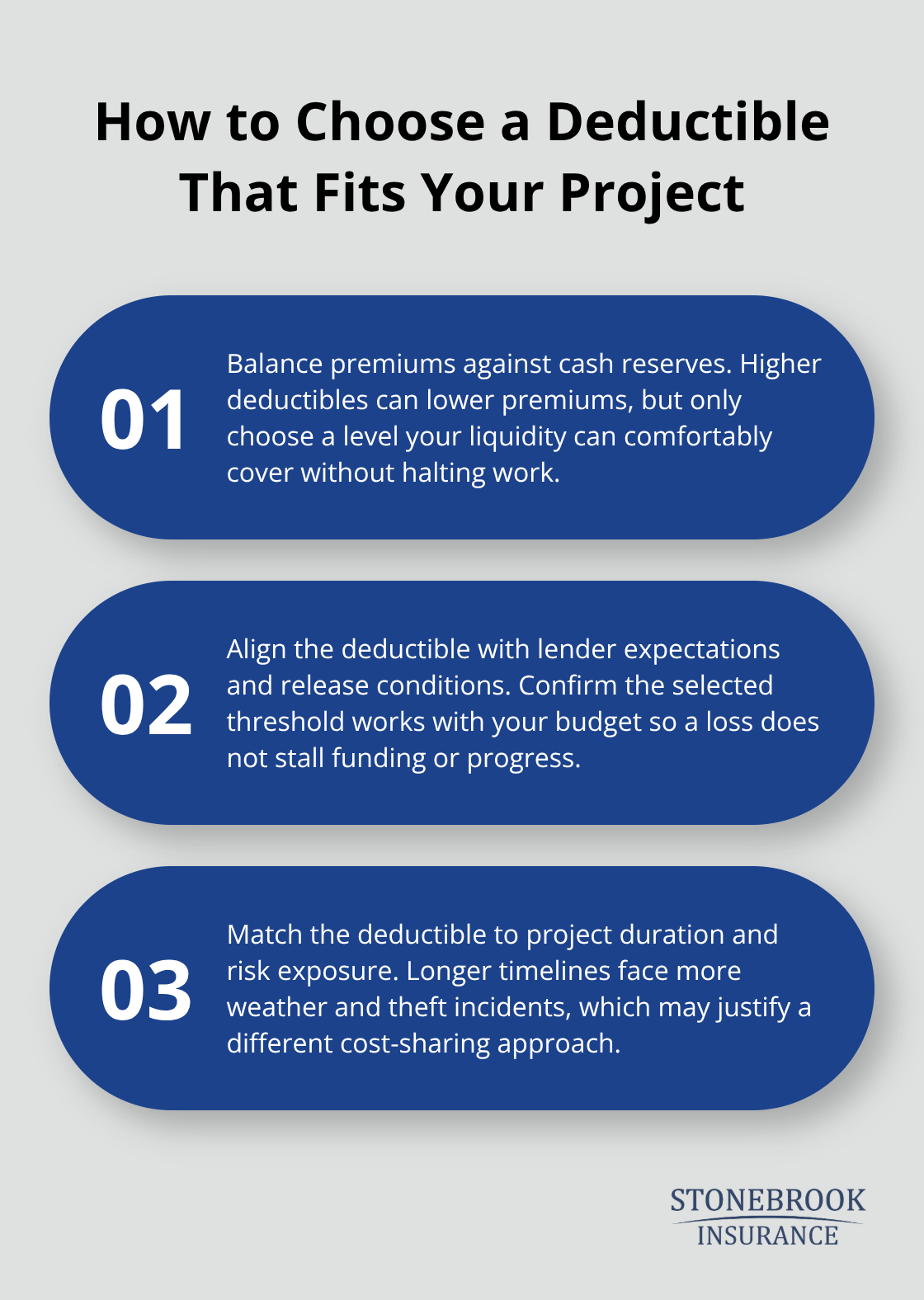
Higher deductibles work only if your cash reserves can absorb the hit without disrupting project operations. If a single loss forces you to pause work because you cannot cover the deductible, you have chosen wrong. Evaluate your actual liquidity position, not your theoretical capacity, when selecting this threshold. Project duration also shapes your coverage structure-a six-month single-family build needs different protection than a two-year multi-unit residential project because longer timelines expose you to more weather events and material theft incidents.
Add Endorsements to Cover Specialized Work
Standard builder risk policies cover basic construction hazards but leave gaps for specialized work that Texas builders commonly perform. If your project includes pool installation, solar systems, or custom masonry, those require specific endorsements or separate coverage because the base policy excludes them. Adding these endorsements costs far less than discovering mid-project that a major component sits uninsured.
Flood coverage presents the most critical gap-standard builder risk excludes flood damage entirely, but if your Texas project sits in a flood zone or near drainage areas, separate flood insurance through the National Flood Insurance Program becomes mandatory. Windstorm coverage in coastal Texas counties and high-wind zones often comes with separate deductibles or requires a dedicated windstorm policy, so verify your lender’s requirements and your actual wind exposure before assuming the base policy covers this peril. Soft cost coverage for project delays caused by weather, permitting delays, or utility interruptions protects your carrying costs when work stops. Equipment breakdown coverage matters if you own or rent specialized machinery like tower cranes or concrete pumps; the base policy does not cover equipment failure, only damage from external perils.
Work with Your Agent to Map Coverage Gaps
The relationship between you and your insurance agent determines whether your policy actually protects your business or leaves you dangerously exposed. An agent who simply quotes you a standard builder risk policy without asking detailed questions about your project scope, timeline, materials, and equipment has not done their job. Bring your project plans, timelines, material lists, and equipment schedules to the conversation so your agent understands exactly what sits on-site and for how long.
A strong agent maps every phase of construction and identifies which perils pose the greatest risk to each phase-foundation work faces different exposures than framing, which differs from finishing. This phase-by-phase approach prevents you from overpaying for coverage you do not need while leaving critical gaps in protection. Your agent should also verify that your lender’s requirements align with your actual coverage, because lenders sometimes demand specific endorsements or loss payee arrangements that require advance coordination. Do not accept a quote without confirming that your policy meets both your lender’s requirements and your project’s real hazards.
Final Thoughts
Builder risk insurance protects your Texas construction projects from weather damage, material theft, equipment loss, and project delays that drain profitability. The coverage you need depends on your total project cost, your cash position, and the specific hazards your sites face. Underestimating your coverage limits or skipping specialized endorsements creates gaps that cost far more than the premium savings ever justified.
Your lender requires this protection before releasing construction capital, which means builder risk insurance isn’t optional-it’s a prerequisite to financing and a business necessity for protecting your operation across multiple simultaneous builds. We at Stonebrook Insurance work with Texas builders to structure policies that match their actual project risks and lender requirements. Our team shops multiple major carriers to find competitively priced coverage tailored to your construction timeline, equipment, and exposure profile.
Contact Stonebrook Insurance to discuss your builder risk insurance needs and receive a customized quote that protects your investment from start to finish.
The information provided in this blog is for general informational purposes only and does not constitute legal, financial, or insurance advice. Coverage options, terms, and availability may vary. Please consult with a licensed professional for advice specific to your situation.
Artificial intelligence may have been used to generate text and images in some blog articles.