

Growing contractors face a hard truth: one accident or equipment loss can wipe out months of profit. Small contractor insurance isn’t optional-it’s the difference between staying in business and closing your doors.
At Stonebrook Insurance, we’ve seen too many contractors operate with gaps in their coverage. The good news is that the right protection is within reach, and it doesn’t have to be complicated.
The Three Coverage Types Every Contractors Must Have
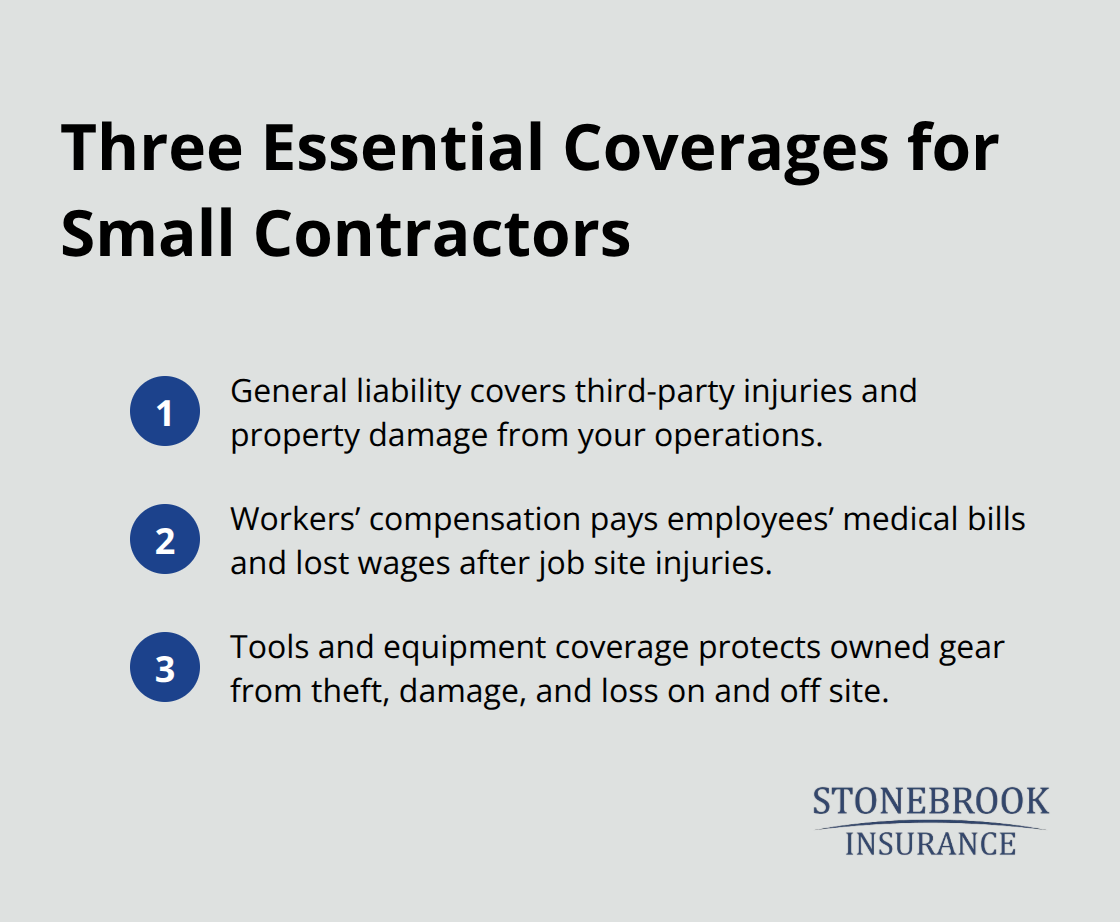
General Liability Protects Your Bottom Line
General liability coverage protects you when someone gets hurt on your job site or your work damages their property. A single lawsuit costs $10,000 to $25,000 in legal fees alone. Most contractors carry $1 million in general liability limits, though this depends on your project size and client requirements. Larger commercial clients often demand $2 million or higher. The cost runs between $40 and $80 per month for small contractors, making it one of your cheapest insurance investments relative to the protection it provides.
Workers’ Compensation Keeps You Legal and Protected
Workers’ compensation is mandatory in every state except Texas, where it’s optional but strongly recommended. If an employee gets injured, workers’ comp covers their medical bills and lost wages, which protects you from lawsuits. In states where it’s required, operating without it results in fines starting at $5,000 and climbing quickly. The National Safety Council reports that the average workers’ compensation claim for a serious injury costs $40,000 in direct and indirect expenses. Your premium depends on your payroll size and the riskiness of your work-roofing costs more than carpentry, for example. Even in Texas, skipping workers’ comp is risky because employees can still sue you for negligence if injured.
Tools and Equipment Need Real Protection
Your tools and equipment are your income stream, yet most contractors keep them underprotected. Standard commercial general liability policies don’t cover your own tools-they only cover damage you cause to someone else’s property. You need inland marine coverage or a tools and equipment policy to protect saws, compressors, scaffolding, and vehicles from theft, damage, or loss. A contractor losing $15,000 in equipment to job site theft struggles for months recovering that cash flow. Coverage typically costs $30 to $100 per month depending on the total value of equipment you carry.
Document what you own with serial numbers and photos, then update your coverage annually as you acquire new tools.
Subcontractor Liability Exposure Catches Many Off Guard
Subcontractor liability exposure trips up many growing contractors. When you hire subcontractors, you’re responsible for their actions on the job site, even though you don’t employ them directly. If a subcontractor’s negligence injures someone or damages property, you can be held liable for their mistakes. This gap costs contractors thousands in unexpected legal bills. Verify that every subcontractor carries their own liability insurance and list you as an additional insured on their policy before work starts. Some contractors add contractual liability coverage to their policy to address this specific exposure.
These three coverage types form your foundation, but they’re only the start. Many contractors discover their real vulnerabilities when they face the gaps that actually drain their accounts.
Common Insurance Gaps That Cost Contractors Money
Inadequate Coverage Limits Drain Your Accounts
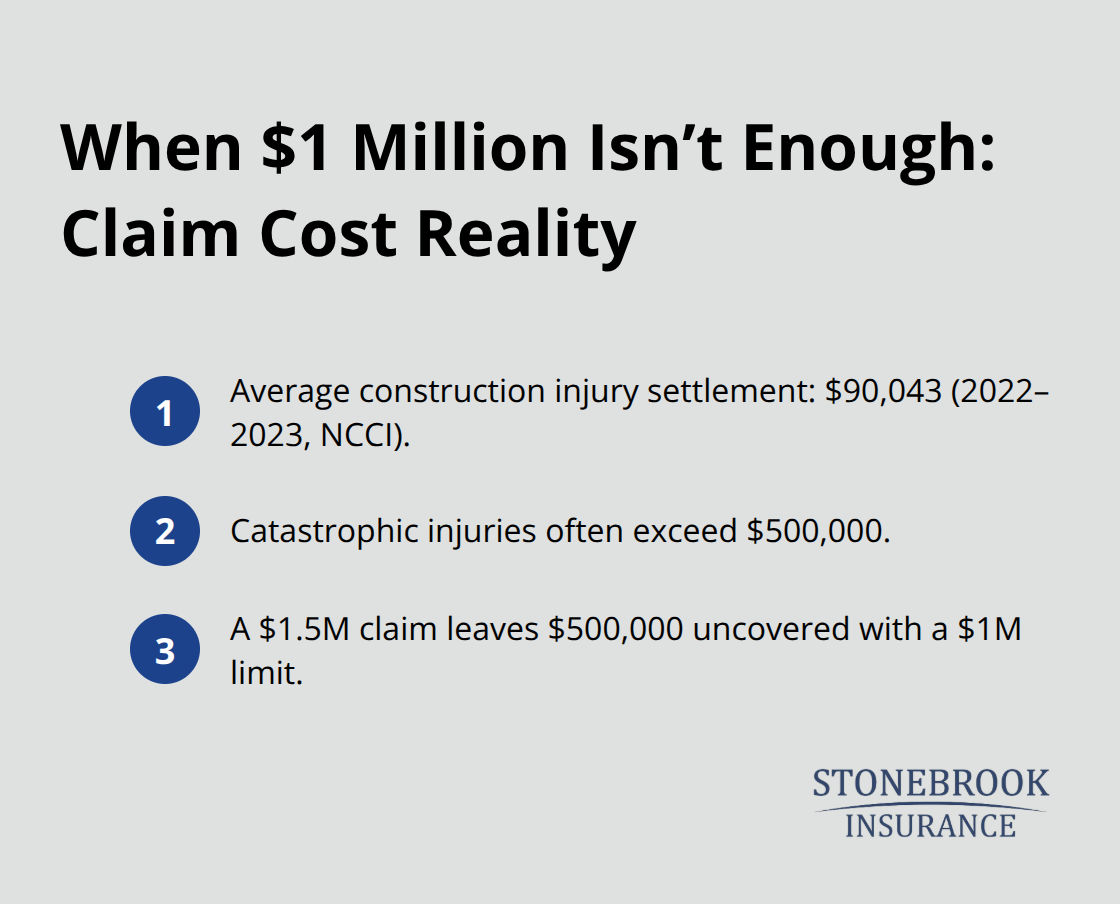
Most contractors pick insurance limits based on what sounds reasonable rather than what their actual exposure demands. A $1 million general liability limit seems substantial until you face a serious injury claim. The National Council on Compensation Insurance reports that construction injury settlements averaged $90,043 per claim in 2022 and 2023, and catastrophic injuries regularly reach $500,000 or more. When your limit is $1 million and the claim hits $1.5 million, you write a check for $500,000 from your business account.
This is where contractors learn too late that their coverage was undersized.
Growing firms handling larger projects or working with commercial clients need honest conversations about their actual exposure. A roofing contractor working on multi-story buildings faces different risks than a finish carpenter, yet many carry identical limits. The premium difference between $1 million and $2 million in general liability is often just $15 to $30 per month, yet contractors skip this upgrade to save money they’ll regret losing.
Umbrella Policies Protect What Your Primary Coverage Misses
Umbrella policies sit unused by contractors who don’t understand their function, which is expensive oversight. An umbrella policy kicks in when your primary coverage limits are exhausted, adding an extra $1 million or $2 million of protection for roughly $200 to $400 annually. Without it, a single major incident wipes out your business assets.
Contractors handling residential work often skip these protections thinking their project sizes don’t warrant them, then face six-figure claims that change their perspective permanently. Those who maintain umbrella coverage view it as non-negotiable, not optional, because they’ve seen what happens when a claim exceeds primary limits.
Subcontractor Liability Exposure Compounds Your Risk
Subcontractor liability exposure compounds this risk because you’re legally responsible for their actions even though you don’t control their work quality. A subcontractor’s negligence causing a serious injury becomes your liability claim, and if that subcontractor carries inadequate coverage, you absorb the gap. Requiring subcontractors to carry $1 million in liability and listing you as an additional insured provides some protection, but it doesn’t eliminate your responsibility if their coverage proves insufficient.
These gaps expose your business to financial ruin, yet they’re preventable with the right strategy and partner. Selecting the right insurance provider makes the difference between catching these exposures early and discovering them in a courtroom.
How to Choose the Right Contractor Insurance Provider
Shop Multiple Carriers for Better Rates
Choosing an insurance provider matters far more than most contractors realize, yet many pick their agent based on whoever answers the phone first or quotes the lowest price. This approach costs money. The right partner catches coverage gaps before they become disasters, negotiates better rates across multiple carriers, and responds fast when you file a claim.
Start your search by contacting three to five agencies that specialize in contractor insurance rather than general commercial coverage. Agencies focused on construction understand that a roofing contractor’s risks differ drastically from a landscaper’s, and they price accordingly. When you call, ask each agency which carriers they represent. Agencies working with five to ten major carriers can shop your coverage properly, while single-carrier agents have limited flexibility and will push you toward whatever that carrier offers.
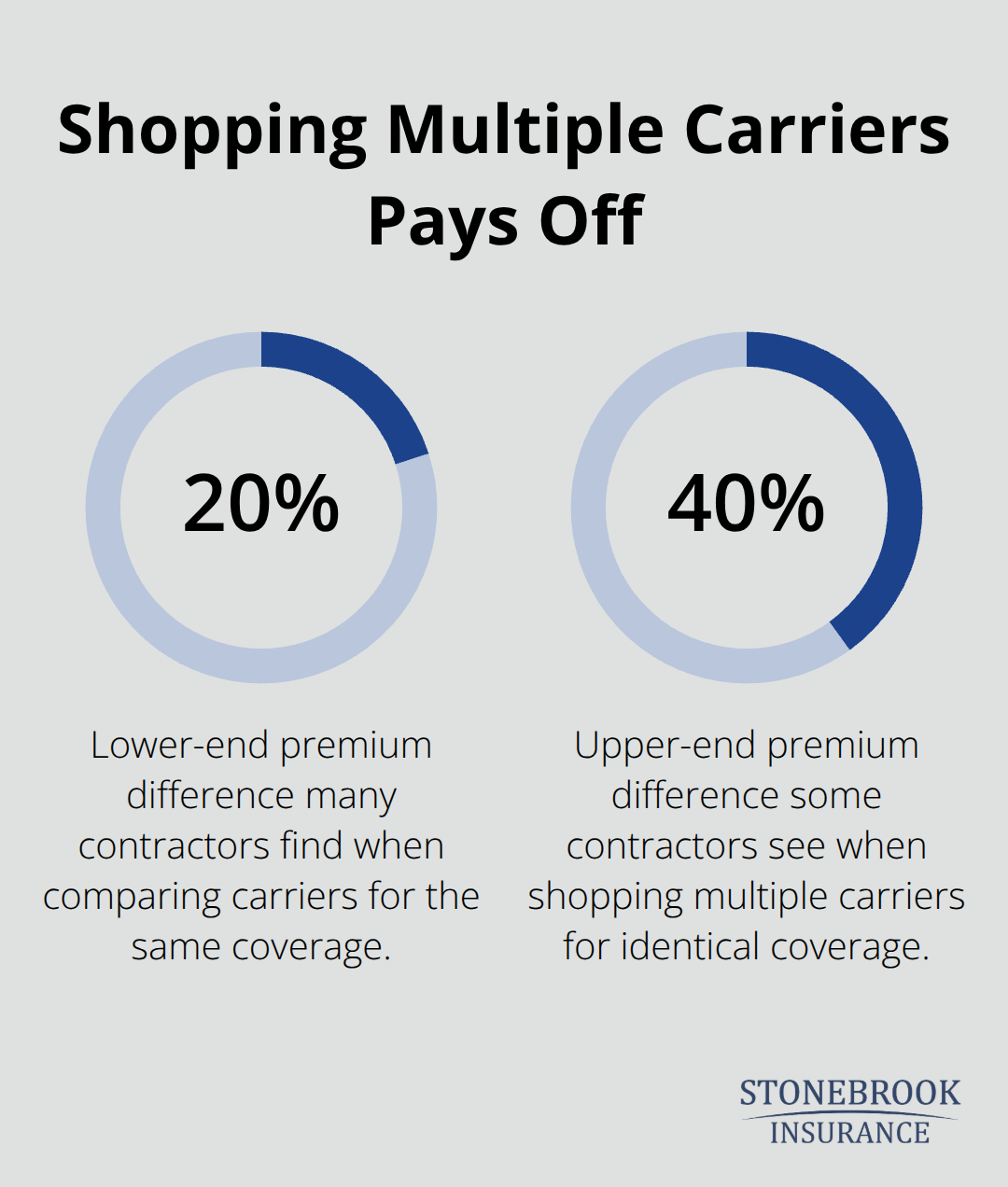
Request quotes from each agency on identical coverage limits-typically $1 million general liability, $1 million per occurrence workers’ compensation, and $500,000 in tools and equipment coverage. This consistency lets you compare apples to apples instead of getting confused by different proposals. You’ll often find rate variations of 20 to 40 percent between carriers for identical coverage, which means shopping saves real money.
An agency worth your time spends 15 to 30 minutes understanding your specific operations, project types, and equipment values before quoting you anything.
Verify Local Expertise and Industry Knowledge
Local expertise matters because workers’ compensation requirements vary significantly by state, and contractors operating across state lines face compounding complexity. An agency familiar with your specific region knows which carriers offer the best rates in your area and which ones have poor claims reputations locally. Local presence lets you work with agencies that serve contractors with hands-on support rather than outsourced call centers.
Assess Claims Support and Response Times
When evaluating an agency’s claims support, ask them directly how fast they respond to claims and whether they have someone who handles claims locally or if it routes to a distant regional office. Contractors filing claims during emergencies need someone who picks up the phone and knows their account, not an automated system directing them to press buttons.
Request the contact information for two current contractor clients and ask them about their claims experience. How fast did the agency respond? Did someone visit the job site? Were claims paid within 30 days? These details reveal whether an agency actually supports contractors or just sells them policies.
An agency should also provide annual reviews of your coverage to account for business growth, equipment additions, and changing project types. Contractors who grow from residential work to commercial projects need coverage adjustments, and a proactive agency initiates these conversations rather than waiting for you to figure it out yourself.
Final Thoughts
The foundation of a thriving contracting business rests on three essential coverage types: general liability to protect against job site accidents, workers’ compensation to meet legal requirements and shield your employees, and tools and equipment coverage to safeguard your income-generating assets. These form your baseline protection, but they work only when paired with adequate limits and supplemental coverage like umbrella policies that catch what your primary policies miss. Small contractor insurance protects your bottom line and lets you grow without fear.
Selecting the right insurance partner determines whether you catch coverage gaps before they become financial disasters. An agency that specializes in contractor insurance understands your specific risks better than generalists, shops multiple carriers to find competitive rates, and responds quickly when claims happen. The difference between an agency that sells you a policy and one that actively supports your business shows up during emergencies, annual reviews, and growth transitions.
We at Stonebrook Insurance have spent more than 30 years helping contractors across Texas secure tailored coverage that matches their actual exposure. Our family-owned approach means you work with people who understand your business, not distant representatives reading from scripts. Visit us at Stonebrook Insurance to discuss how we can strengthen your contractor insurance protection.
The information provided in this blog is for general informational purposes only and does not constitute legal, financial, or insurance advice. Coverage options, terms, and availability may vary. Please consult with a licensed professional for advice specific to your situation.
Artificial intelligence may have been used to generate text and images in some blog articles.