

Contractor insurance quotes can vary wildly from one provider to the next, and picking the wrong policy could leave you exposed to serious financial risk. Most contractors we work with at Stonebrook Insurance admit they’ve wasted time comparing quotes without a clear strategy.
The good news is that comparing quotes doesn’t have to be complicated. With the right approach, you’ll spot the real differences between policies and find coverage that actually protects your business.
What Separates a Strong Quote from a Weak One
Contractor insurance quotes aren’t just about the price you see at the top. Two quotes that look similar on the surface can be dramatically different when you examine what’s actually covered. General liability coverage limits serve as the universal baseline for commercial construction contracts, and selecting the wrong limit can either leave you underprotected or waste money on coverage you don’t need.
A roofing contractor needs different limits than a landscaper, and a quote that works for one won’t work for the other. You should know your project sizes, your annual revenue, and your typical contract values before you request a quote. This information determines what limits make sense for your operation.
What Your Deductible Really Costs You
Deductibles trip up contractors more often than any other factor. A lower deductible feels safer, but it increases your premium significantly. If you choose a $500 deductible instead of a $2,500 deductible, you’ll pay 15 to 25 percent more annually-that’s real money.
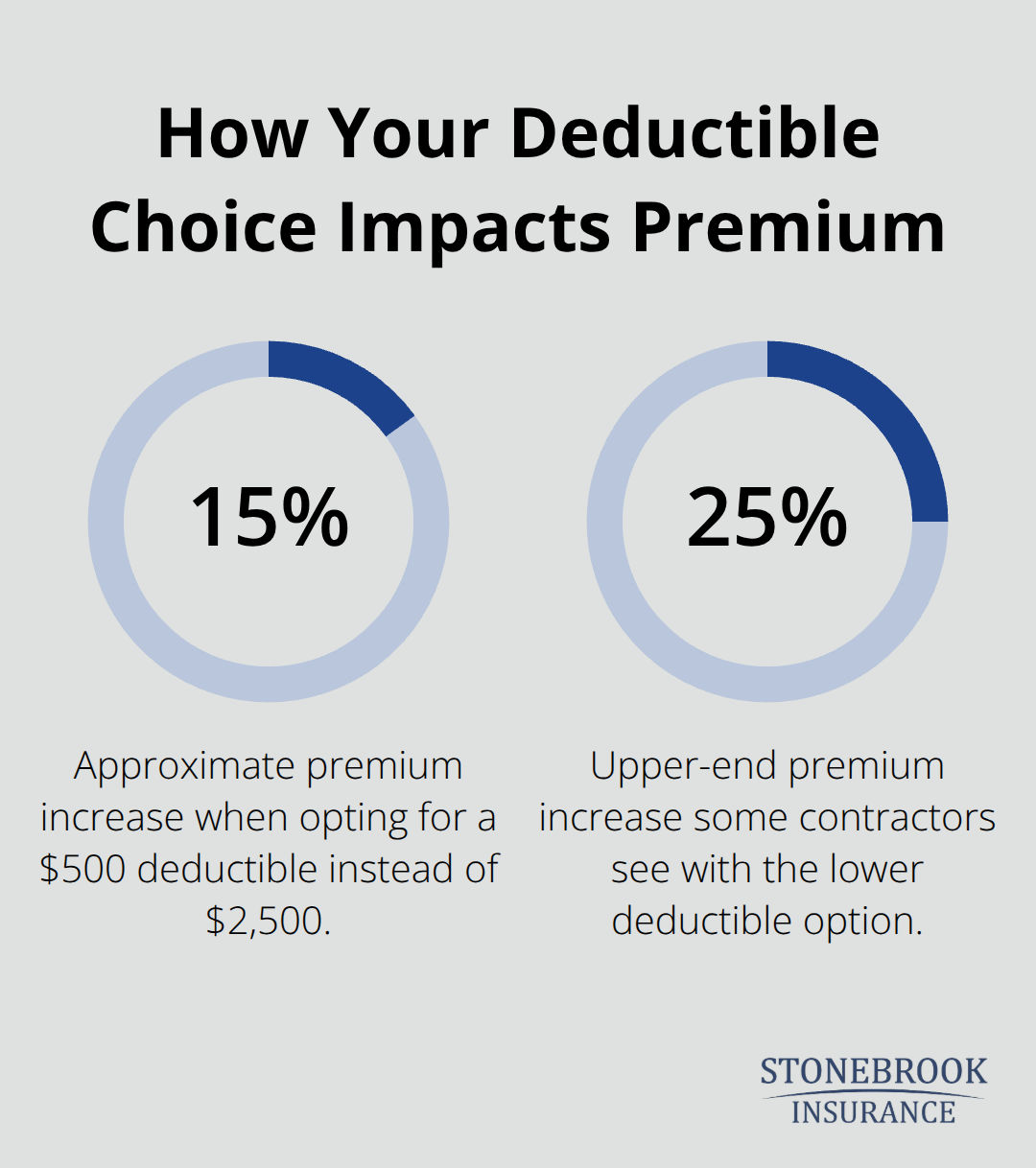
The question isn’t which deductible is best in theory. It’s which one fits your cash flow situation. If you can handle a $2,500 hit without stress, that higher deductible saves you hundreds or even thousands per year. Many contractors find that a $1,000 deductible hits the sweet spot between reasonable premiums and manageable out-of-pocket costs.
Pay attention to whether deductibles apply per claim or per year. A per-claim deductible means you pay it for every single incident, while a per-year deductible caps your total out-of-pocket exposure. This distinction affects your actual financial risk far more than most contractors realize.
The Hidden Damage in Exclusions
Exclusions are what insurers use to avoid paying claims, and they’re buried in the fine print of every quote. Some policies exclude equipment left unattended on job sites, others exclude damage from weather conditions, and some exclude work performed at heights over certain distances. These aren’t minor details-they’re the difference between a claim being paid and being denied.
A contractor doing exterior work absolutely needs to verify that weather-related damage isn’t excluded. A contractor using aerial lifts needs to confirm height restrictions don’t apply to their work. Read the exclusions section in every quote you receive, and if something looks questionable, ask the agent directly whether it affects your specific type of work.
The exclusions section reveals what the insurer won’t cover, and that’s exactly what you need to know before you commit to a policy. Once you understand what separates strong quotes from weak ones, you’re ready to gather multiple quotes and compare them side by side.
How to Gather and Compare Contractor Insurance Quotes
Request Quotes from Multiple Carriers
Three quotes is the bare minimum, but five works better. Contractor insurance pricing varies dramatically between carriers, and you need enough data points to spot which providers actually understand your type of work. A roofing contractor might receive quotes ranging from $1,200 to $2,800 annually for identical coverage from different insurers, simply because some carriers specialize in roofing and price it competitively while others treat it as a niche risk.
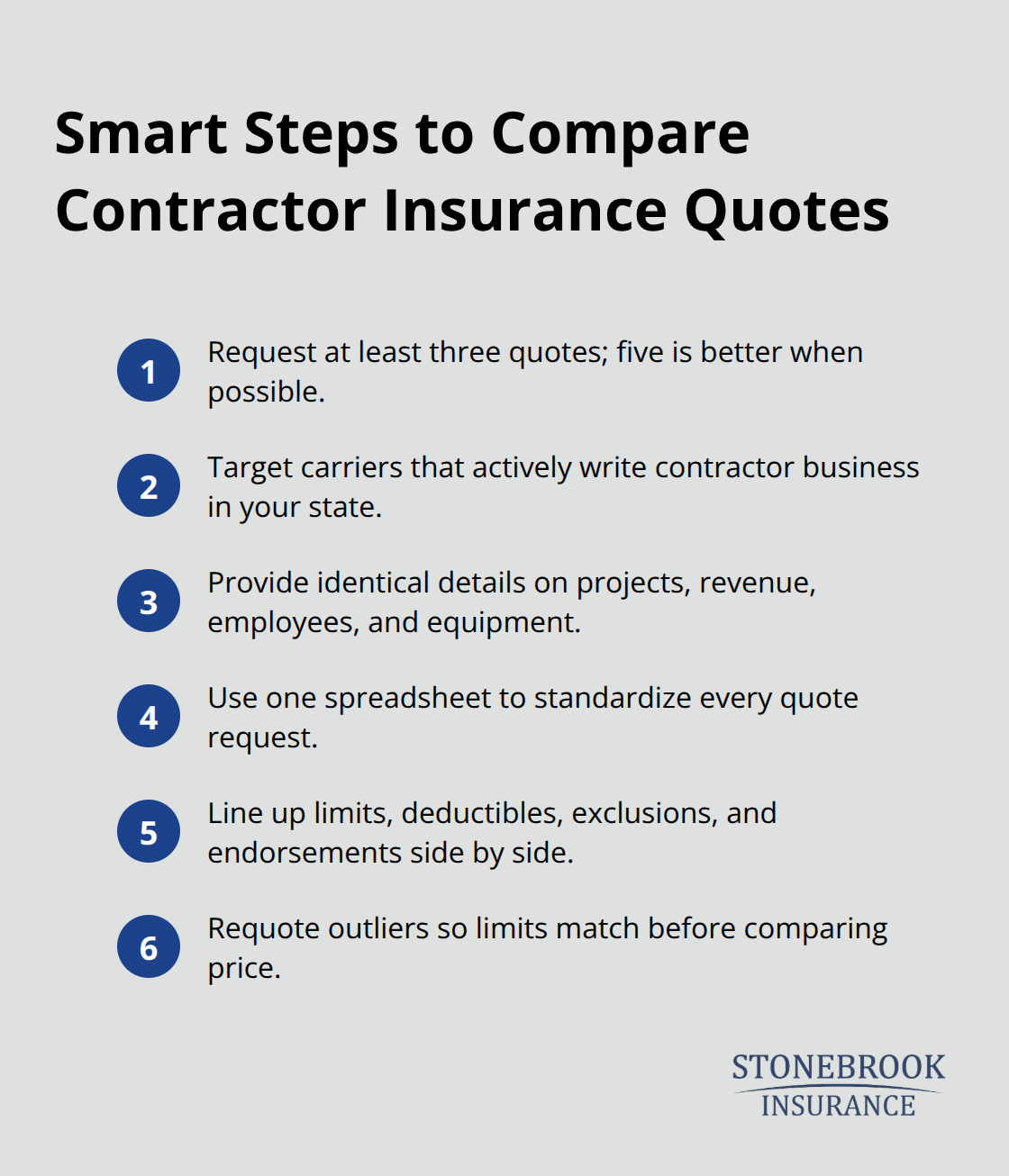
Contact carriers that actively write contractor business in your state, not national providers who treat your work as an afterthought. When you reach out to each insurer, provide identical information about your business: the same project types, the same revenue figures, the same number of employees, and the same equipment values. This standardization matters because slight variations in how you describe your operation can trigger different underwriting decisions and pricing tiers.
Standardize Your Information Across All Requests
One carrier might ask about your safety record differently than another, and how you answer affects your premium. Create a simple spreadsheet with your business details and use that exact same information for every quote request. This removes the guesswork and ensures you’re actually comparing apples to apples.
When you submit information to each carrier, consistency determines whether your comparison holds any value. Different descriptions of the same work can produce wildly different quotes, making it impossible to know whether price differences reflect actual market rates or just poor communication on your part.
Line Up Coverage Limits Side by Side
Pull out each quote and list the coverage limits side by side. General liability limits, property coverage limits, equipment coverage limits, and any specialty coverages should all be identical across your comparison sheet. If one quote includes $1 million in general liability and another includes $2 million, that’s not a fair price comparison.
Adjust the lower limit to match and ask the insurer to requote, or you’re wasting time. Next, examine the deductibles, exclusions, and endorsements on each quote. A $500 difference in annual premium might disappear entirely once you account for different deductibles or missing coverage. Some carriers include coverage for tools left in vehicles; others require a separate endorsement that costs extra. Document these differences explicitly.
Calculate Your True Cost, Not Just the Premium
Calculate your true cost by adding the premium to your expected out-of-pocket exposure based on deductible levels. A policy costing $200 less annually but with a $2,500 deductible instead of $1,000 might actually cost you more when you factor in real-world claims. The cheapest quote rarely delivers the best value, and comparing only prices guarantees you’ll make a poor decision.
Once you’ve identified which quotes actually match in coverage and which ones offer genuine value, you’re ready to spot the mistakes that trip up most contractors when they make their final selection.
Common Mistakes Contractors Make When Comparing Quotes
Price Becomes the Only Decision Factor
Contractors consistently sabotage their own quote comparisons by fixating on a single number instead of evaluating what that number actually buys. The lowest premium wins the mental battle, but the lowest premium often masks coverage gaps that surface only after a claim gets denied. A contractor paying $1,400 annually for general liability might think they’re beating a competitor paying $1,800, but if the cheaper quote excludes equipment damage and the expensive one includes it, the price advantage evaporates the moment something breaks on the job site.
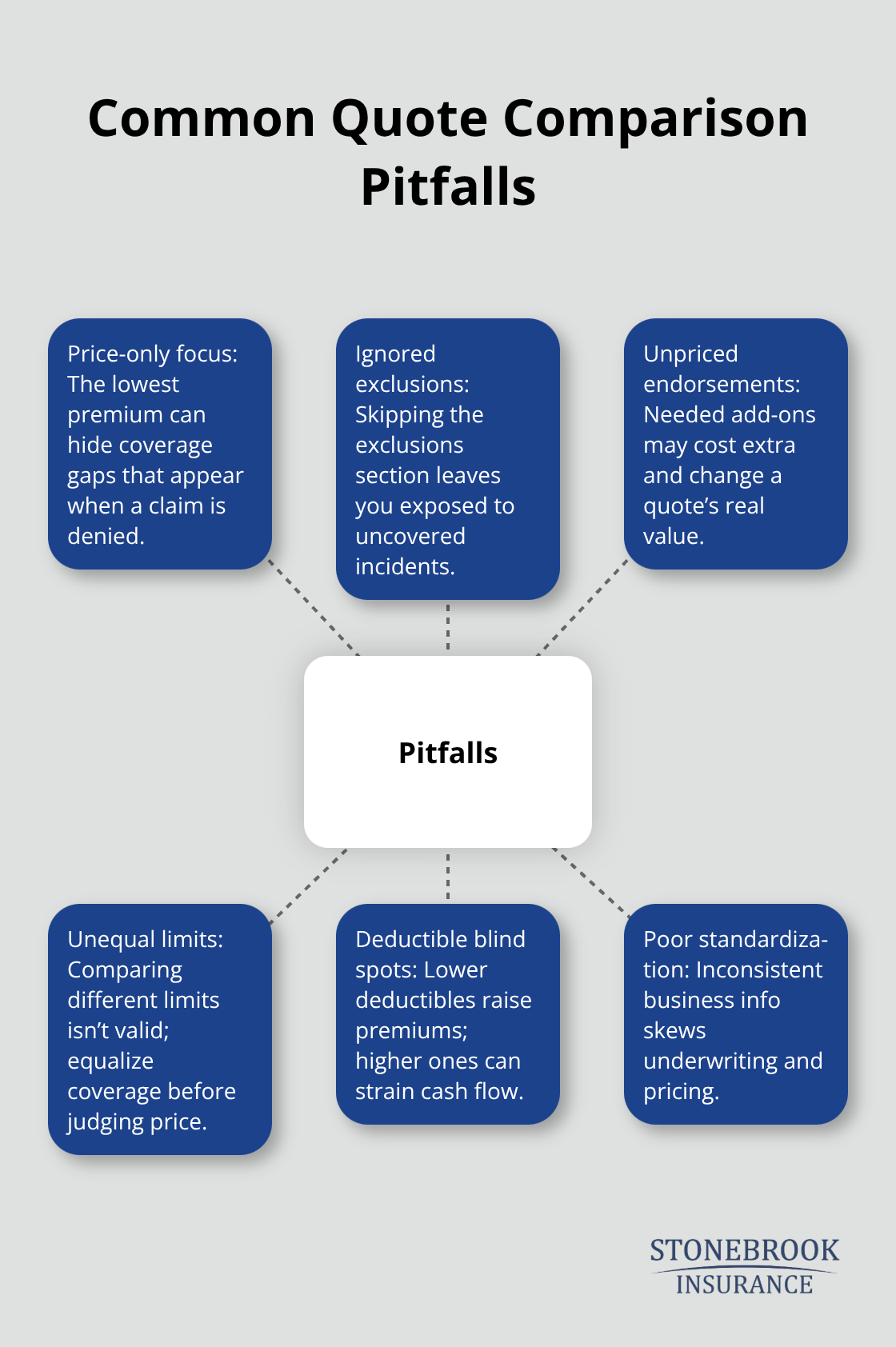
The mistake isn’t mathematical; it’s strategic. You need to calculate total cost of risk ownership, which means adding your annual premium to your realistic deductible exposure and subtracting any exclusions that force you to buy separate coverage elsewhere. A $1,200 policy with a $2,500 deductible and no equipment coverage actually costs far more than a $1,800 policy with a $1,000 deductible that includes equipment protection.
Exclusions Get Overlooked or Misunderstood
The second critical error happens when contractors skip the exclusions section entirely or scan it without understanding it in relation to their actual work. Exclusions written in dense insurance language feel abstract until you stand on a job site with a denied claim. A roofing contractor might overlook an exclusion for wind damage, thinking it won’t matter until a storm hits mid-project. A concrete contractor might miss an exclusion for equipment left unattended, only discovering it after tools disappear from a weekend site.
These aren’t small oversights-they’re the difference between having insurance that works and having a policy that exists only to collect premiums. Read exclusions actively by asking yourself whether each one applies to your specific operations. If anything seems questionable, contact the agent before you sign.
Endorsements and Policy Conditions Hide Extra Costs
Your final mistake involves committing to a policy without reviewing the actual endorsements and conditions that modify coverage. Some quotes include endorsements as standard; others charge extra for them. A contractor needing coverage for employees working at heights might find one quote includes aerial lift coverage while another requires a separate endorsement costing $300 annually. These gaps compound across multiple coverage types, turning a seemingly competitive quote into an expensive liability trap.
Spend thirty minutes comparing the actual policy documents, not just the summary pages. You’ll avoid most of the expensive mistakes your competitors are making right now. The difference between a quote that protects your business and one that leaves you exposed often comes down to whether you actually read what the insurer won’t cover.
Final Thoughts
Contractor insurance quotes require you to standardize your information across all requests, examine coverage limits and exclusions side by side, and calculate your true cost rather than fixating on premiums alone. Most contractors waste time gathering quotes without a clear strategy, then make rushed decisions based on price alone. That approach leaves gaps in coverage that surface only when claims get denied.
The real work happens after you collect multiple quotes. You need to verify that deductibles, exclusions, and endorsements match across all options before you can make a meaningful price comparison. A $500 annual savings disappears quickly when you discover your cheaper policy excludes equipment damage or requires additional endorsements you didn’t budget for (spending the time upfront to understand what each quote actually covers prevents the expensive mistakes that plague contractors who skip this step).
Working with a local agent who understands contractor operations makes this entire process simpler. At Stonebrook Insurance, we shop multiple major carriers on your behalf, which means you get competitive pricing without spending weeks gathering quotes yourself. Contact Stonebrook Insurance to discuss your contractor insurance needs with someone who understands your specific risks.
The information provided in this blog is for general informational purposes only and does not constitute legal, financial, or insurance advice. Coverage options, terms, and availability may vary. Please consult with a licensed professional for advice specific to your situation.
Artificial intelligence may have been used to generate text and images in some blog articles.