

Picking the right home insurance policy feels overwhelming when you’re staring at dozens of options. A home insurance coverage comparison helps you understand what you’re actually paying for and whether your protection matches your needs.
At Stonebrook Insurance, we’ve helped countless homeowners navigate this decision by breaking down the coverage types, rate factors, and comparison strategies that matter most.
What Your Home Insurance Actually Covers
Your standard homeowners policy protects four distinct areas, and understanding each one prevents you from buying coverage you don’t need or leaving gaps that could cost thousands.
Dwelling Coverage: The Foundation of Your Protection
Dwelling coverage pays to rebuild your house if it’s damaged or destroyed, covering the structure itself, attached garages, decks, and permanent fixtures like built-in appliances. This is where replacement cost value matters most. Consumer Reports found that the typical annual home insurance premium runs about $1,695 across nearly 24,000 surveyed policyholders, but your dwelling coverage amount directly influences that cost. If your home would cost $400,000 to rebuild from scratch and you only insure it for $300,000, you’re underinsured and facing serious financial exposure. Most mortgage lenders require replacement cost coverage, which means the insurer pays what it actually costs to rebuild, not a depreciated amount.
Personal Property Coverage and High-Value Items
Personal property coverage protects your belongings inside the home-furniture, electronics, clothing, and household goods. Standard policies typically cover personal property at 50 to 70 percent of your dwelling coverage limit, but this is often too low. If your dwelling is insured for $400,000, your contents might only be covered for $200,000, which can leave expensive items unprotected. A home inventory matters significantly here.
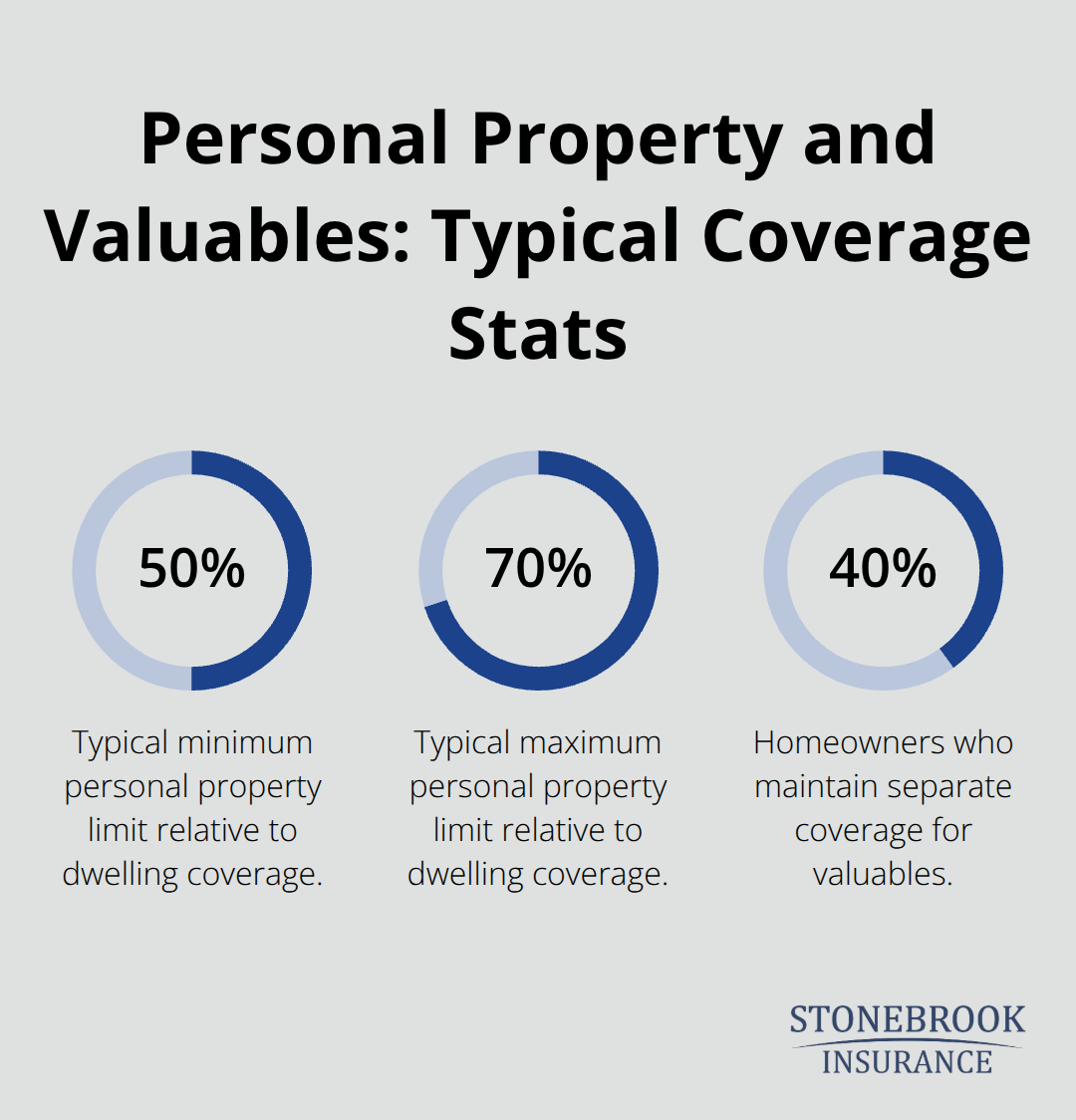
You should document what you own with photos or video, note purchase dates and values, and keep this list accessible. High-value items like jewelry, art, or collectibles usually hit a per-item limit of $1,500 to $2,500 on standard policies, so you’ll need separate riders or endorsements to cover them fully. About 40 percent of homeowners maintain some separate coverage for valuables according to Consumer Reports, and that’s a smart move if you own anything worth more than your policy’s blanket limit.
Liability Coverage and Umbrella Protection
Your liability protection covers you if someone is injured on your property or if you accidentally damage someone else’s property, and most policies start around $100,000. This sounds substantial until you consider that a serious injury lawsuit can exceed $500,000 or $1,000,000 in damages. If a guest slips in your kitchen and requires surgery, or a neighborhood child is injured in your yard, liability coverage pays their medical bills and legal fees up to your limit. For homeowners with significant assets or higher income, starting with $100,000 is actually risky. An umbrella policy layered on top of your homeowners liability provides an additional $1,000,000 or more in protection at a relatively low cost (often $150 to $300 per year). Additional living expenses are the fourth component of your standard policy, covering hotel, restaurant meals, and other costs if you must leave your home during repairs after a covered loss. This protection typically covers 20 to 30 percent of your dwelling limit and activates only after a claim.
Optional Riders That Fill Critical Gaps
Beyond these four basics, optional riders expand coverage for specific risks. Sewer backup coverage costs roughly $50 to $300 annually and covers $5,000 to full replacement value, protecting you from one of the costliest surprises homeowners face. Flood insurance must be purchased separately through the National Flood Insurance Program or private carriers, and standard homeowners policies exclude all external flooding. Even if you’re in a moderate-risk flood zone, coverage costs less than most people expect, and you can obtain instant quotes through official flood insurance resources. Earthquake coverage, windstorm protection in coastal areas, and replacement cost endorsements for contents are other additions worth evaluating based on your location and assets. The right combination of base coverage and riders depends entirely on what you own and where you live-which is exactly why comparing policies side by side reveals whether one carrier’s quote actually protects you better than another’s.
What Drives Your Home Insurance Premium
Location Sets the Foundation for Your Rate
Your home insurance rate isn’t arbitrary-it’s built on measurable factors that insurers have studied for decades. Location stands as the single most powerful rate driver. If you live in a hurricane-prone coastal area, wildfire-prone region, or tornado alley, your premiums reflect actual risk. A home in Miami costs substantially more to insure than an identical home in rural Nebraska because claims data shows coastal properties face higher loss frequency. The National Association of Insurance Commissioners notes that your distance to the nearest fire department and water source directly influences your premium, as does proximity to natural hazards. Insurers pull public records showing your exact location relative to fire stations and hydrants.
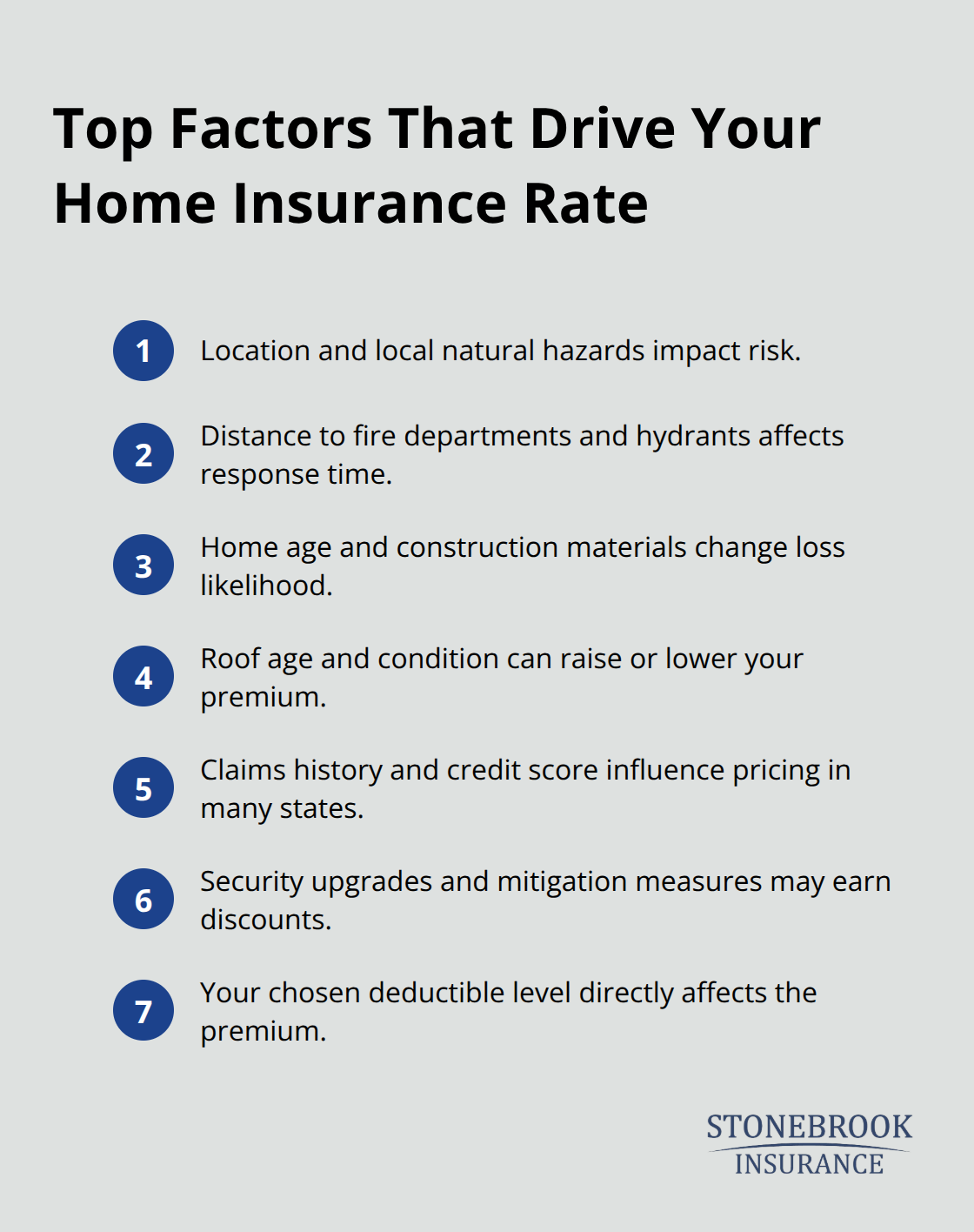
If your home sits three miles from the nearest fire department instead of half a mile away, your premium reflects that measurable difference in response time.
Flood Risk Requires Separate Evaluation
Flood risk deserves separate attention because standard policies exclude all external flooding. You can check your flood risk using FEMA flood maps, but FirstStreet.org provides free risk assessments that often reveal flood exposure FEMA maps miss. Even if you’re in a low-to-moderate risk zone, premiums for flood coverage through the National Flood Insurance Program run surprisingly low-often cheaper than homeowners assume-making it worth obtaining a quote before declining it.
Home Age, Materials, and Condition Shape Your Cost
Your home’s age, construction materials, and size shape your premium just as much as location does. A 60-year-old wood-frame house costs more to insure than a 10-year-old brick home of the same square footage because older homes have aging electrical systems, plumbing, and roofs that fail more frequently. If your roof is over 20 years old, many insurers either decline coverage or charge substantially more. Upgrading to a new roof, installing storm shutters, or adding a home security system generates measurable discounts-typically 5 to 15 percent depending on the improvement and insurer.
Claims History and Credit Impact Your Rates
Your claims history carries surprising weight in rate calculations. A single claim from five years ago can still increase your premium today, and even inquiries about coverage that never resulted in claims sometimes appear on your loss history report. Request a free loss history report from your agent to see exactly what lenders and insurers see about your past, because inaccurate information can inflate your rates unnecessarily. Credit score influences rates in most states, though the relationship is weaker than many assume-it’s one factor among many, not the determining factor. The National Association of Insurance Commissioners emphasizes that home-specific factors matter most: the actual cost to rebuild your home, the materials used, your home’s condition, and whether you’ve made improvements all significantly affect what you’ll pay.
Comparing Quotes Reveals How These Factors Apply to Your Situation
Understanding these rate drivers prepares you to evaluate quotes intelligently. When you obtain quotes from multiple carriers, you’ll notice that one insurer charges more than another for the same home-not because one is wrong, but because each company weights these factors differently and applies its own risk models. The next section walks you through the comparison process itself, showing you how to line up quotes side by side and identify which policy actually delivers the protection you need at a price that makes sense.
How to Compare Home Insurance Policies Effectively
Obtain Multiple Quotes to Understand Your True Market Rate
Obtaining quotes from five to six different insurers is non-negotiable if you want to understand what your home actually costs to insure. Most homeowners stop after one or two quotes and miss the reality that identical coverage can vary by hundreds of dollars annually depending on the carrier’s risk models and underwriting approach. When you request quotes, the insurers will ask for your home’s square footage, age, roof condition, distance to the fire department, and construction materials. These details matter because they directly shape your premium, but they also mean that comparing a $1,200 annual quote against a $1,500 quote requires you to verify that both policies offer the same dwelling coverage amount, personal property limits, deductible, and optional riders.
A cheaper quote that hides a $2,500 deductible instead of your intended $1,000 deductible isn’t actually cheaper-it shifts your financial responsibility if you file a claim. The Texas Department of Insurance offers a shopping tool that displays sample rates across multiple carriers for the same coverage parameters, giving you a baseline for what reasonable quotes should look like in your area.
Build a Side-by-Side Comparison to Spot Real Differences
Create a spreadsheet that lists each insurer’s quote alongside the dwelling coverage limit, personal property coverage amount, liability limit, deductible, any endorsements included, and available discounts. This side-by-side format immediately reveals whether one carrier is genuinely more competitive or simply offers less protection for a lower price. When you review individual quotes, ask each agent or broker to explain why their coverage differs from competitors’ quotes and what specific discounts apply to your situation.
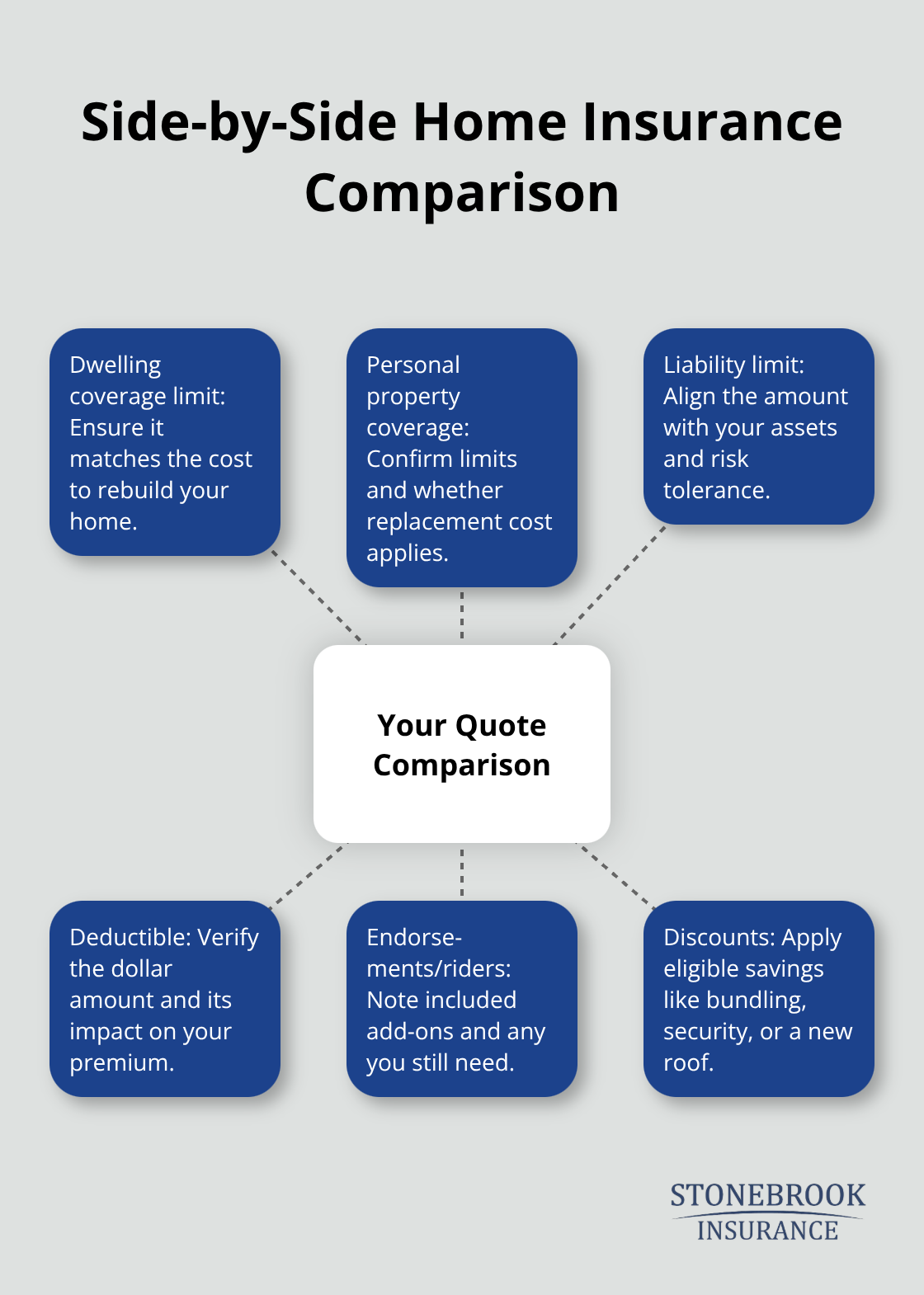
Home security systems, new roofs, bundled auto and home policies, and claims-free histories typically generate savings, but only if you qualify and only if the insurer actually applies them. Try a deductible you can actually afford to pay out of pocket if you need to file a claim, since raising your deductible lowers your premium significantly.
Evaluate Claims Handling and Customer Service Quality
Claims handling speed and customer service quality matter more than most homeowners realize-a policy that saves you $200 annually but takes six weeks to process a claim after a roof leak costs you money in delayed repairs and temporary housing. Check online reviews on independent sites, ask agents directly about their average claims processing time, and verify that the insurer maintains local claims adjusters who can visit your property promptly.
The lowest quote means nothing if the insurer denies your claim or takes months to respond. Your location in Texas may affect which carriers operate in your area and how quickly they can dispatch adjusters, so local availability matters when you compare options.
Final Thoughts
Selecting the right home insurance policy requires more than finding the lowest premium. A home insurance coverage comparison across multiple carriers, careful review of what each policy actually covers, and honest assessment of your protection needs determine whether you’re truly protected or simply paying for inadequate coverage. The factors that drive your rates-location, home age, claims history, and construction materials-are measurable and predictable, which means you can anticipate roughly what your premium should be before you start shopping.
Gather quotes from at least five different insurers using identical coverage parameters, build your side-by-side comparison, and resist the temptation to choose based on price alone. A $300 annual savings disappears quickly if your deductible is $2,500 instead of $1,000, or if your personal property coverage leaves expensive items unprotected. Verify that each quote includes the dwelling coverage amount your lender requires, the liability limit that matches your assets, and any riders you’ve identified as necessary for your situation.
Working with a local agent transforms this process from overwhelming to manageable. At Stonebrook Insurance, we shop multiple major carriers on your behalf, eliminating the legwork of contacting insurers individually while ensuring you understand exactly what you’re buying. Visit Stonebrook Insurance to discuss your coverage needs with agents who understand Texas risks and local market rates.
The information provided in this blog is for general informational purposes only and does not constitute legal, financial, or insurance advice. Coverage options, terms, and availability may vary. Please consult with a licensed professional for advice specific to your situation.
Artificial intelligence may have been used to generate text and images in some blog articles.