

Homeowners insurance premiums in Texas can take a significant bite out of your budget. The good news is that multiple discounts exist if you know where to look.
At Stonebrook Insurance, we help homeowners across Texas uncover savings opportunities they might otherwise miss. This guide walks you through the discounts available and how to maximize them.
What Discounts Can Actually Lower Your Texas Homeowners Insurance Bill
Multi-Policy Bundling Saves Thousands Over Time
Bundling your homeowners and auto policies together typically saves you between 15% and 25% on your annual premiums, according to insurance industry data. This isn’t a minor reduction-on a $1,200 annual homeowners policy, that’s $180 to $300 back in your pocket every year. Most major carriers in Texas offer this discount automatically when you combine policies, but you need to ask about it explicitly. Some insurers require you to maintain both policies continuously to keep the discount active, so switching one policy while keeping the other cancels your savings. Annual reviews of your bundling options matter because rates fluctuate, and what works best today might change next year.
Security Features That Insurers Actually Value
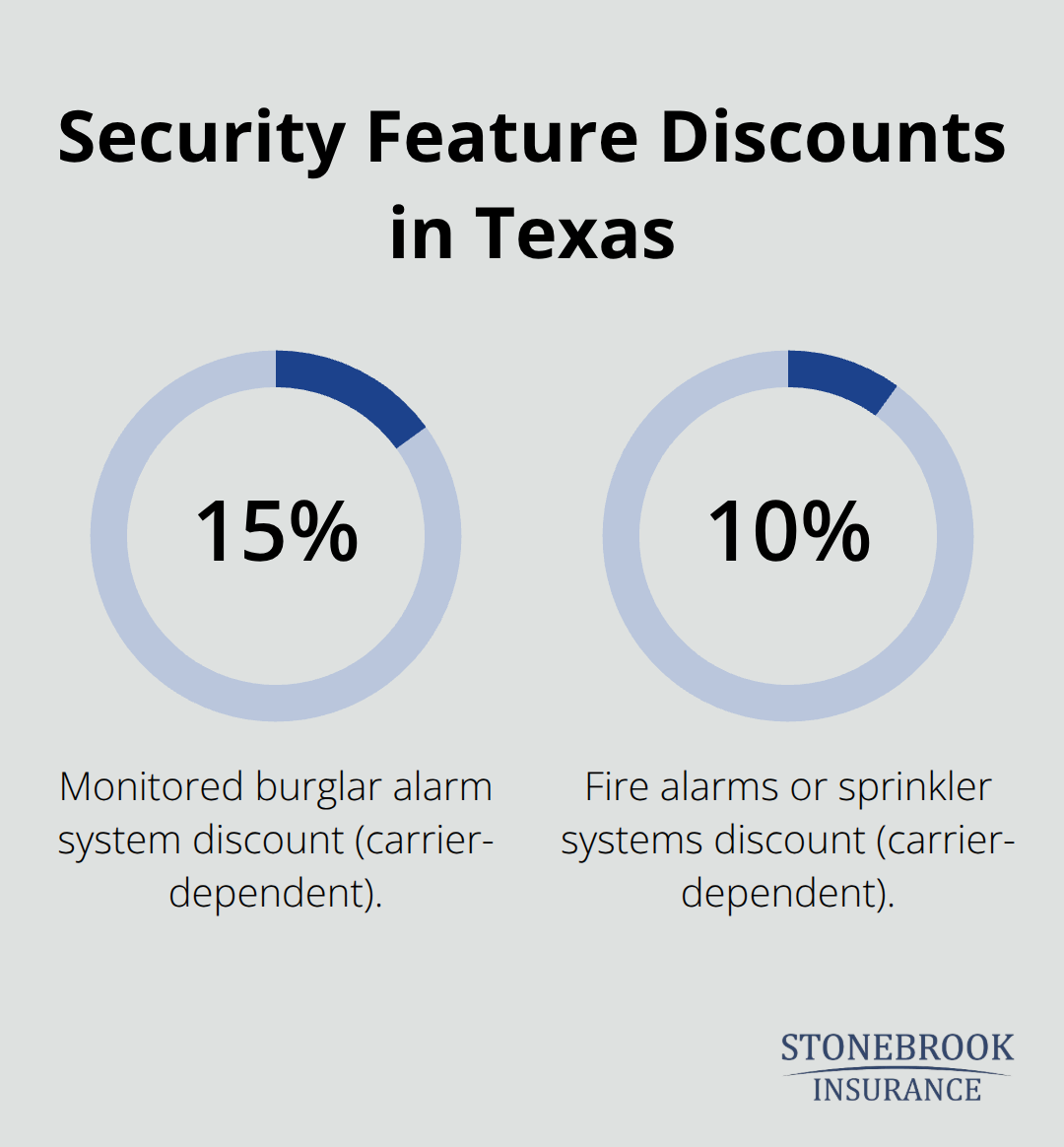
Dead bolt locks, monitored alarm systems, and fire detection equipment reduce your risk profile in ways insurers quantify. A monitored burglar alarm system can earn you a 5% to 15% discount depending on your carrier, while fire alarms or sprinkler systems add another 5% to 10%. The key word is monitored-a system that simply sits there without professional monitoring won’t qualify for discounts at most companies. Texas homeowners who install these features often see the installation costs recoup themselves within two to three years through premium reductions.
Hurricane shutters and impact-resistant windows matter less for most of Texas except in coastal areas, but you should confirm with your specific insurer since some carriers weight storm protection more heavily than others.
Claims-Free Records Pay Real Dividends
Going three to five years without filing a homeowners insurance claim typically qualifies you for a loyalty or claims-free discount ranging from 5% to 10%. This discount actually rewards good fortune-if your roof holds up and your pipes don’t burst, the insurance company acknowledges that action (or inaction) by lowering your rate. Some insurers extend this discount to seven years or more, making it one of the most valuable rewards available. However, this discount can vanish instantly when you file a claim, even a small one, so you should evaluate whether claiming a $2,000 water damage incident makes financial sense against losing a $100 annual discount for the next five years.
Taking the Next Step Toward Lower Premiums
These three discount categories represent the most accessible savings opportunities for Texas homeowners, but your specific situation may qualify you for additional reductions. The real challenge isn’t finding discounts-it’s knowing which combination applies to your home and comparing how different carriers calculate their savings. Shopping multiple carriers reveals significant variations in how they value the same discount, meaning one company’s 10% security feature discount might be worth far more than another’s when applied to different base rates.
How to Actually Lower Your Texas Homeowners Insurance Premiums
Shop Multiple Carriers to Reveal Hidden Savings
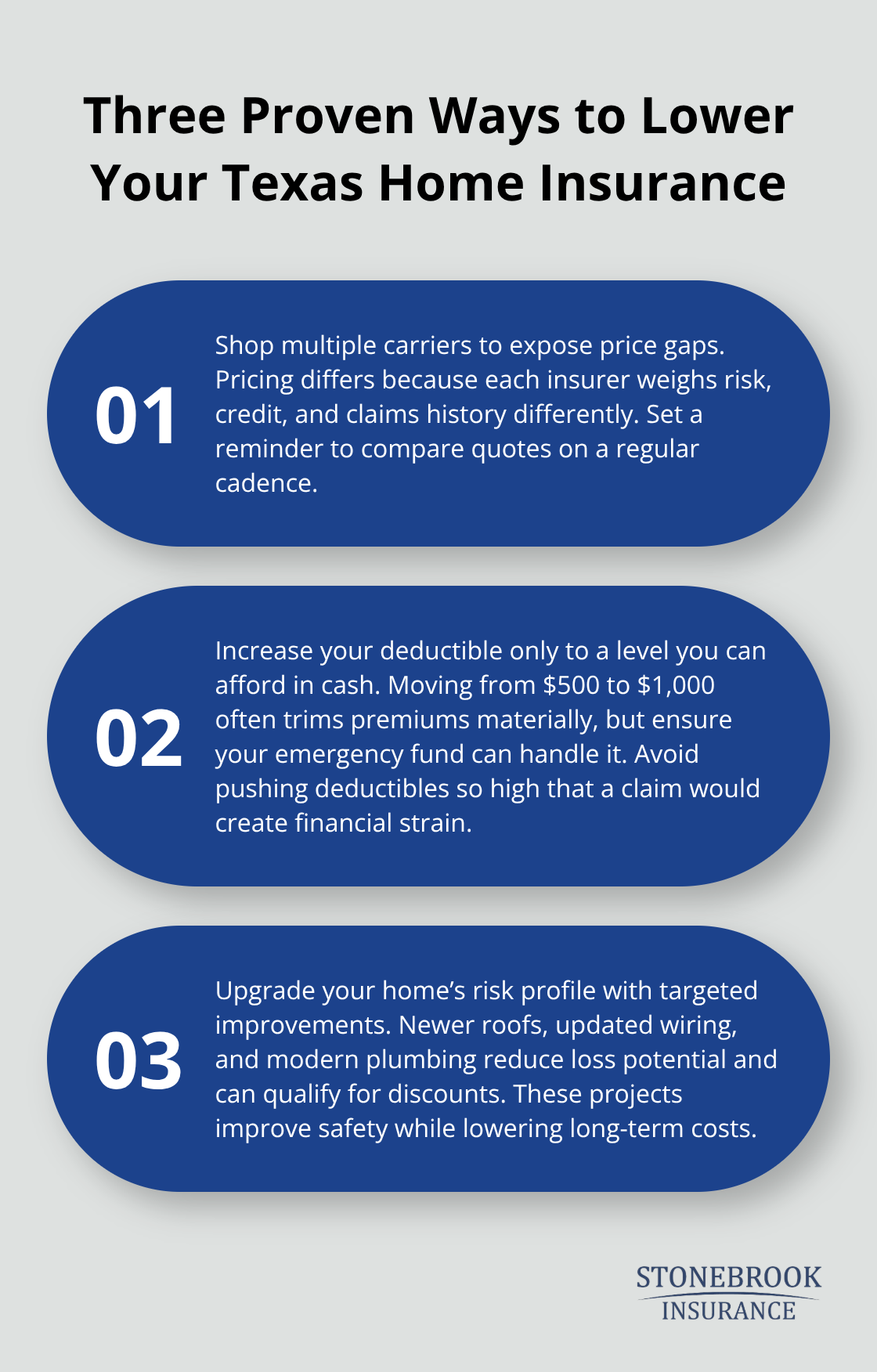
Comparing quotes from different insurers reveals shocking gaps in pricing. Two carriers might offer identical coverage, yet charge $800 and $1,200 annually for the same home in the same neighborhood. The variation stems from how each insurer weighs risk factors, claims history, and credit scores differently. Some carriers heavily penalize older roofs while others ignore them entirely. Others apply strict formulas to credit-based insurance scores that can swing your rate by hundreds of dollars. Spending two hours collecting quotes could save you $200 to $400 annually, which translates to $1,000 to $2,000 over five years. Texas homeowners should request quotes every two to three years since your risk profile changes and carrier appetites shift.
Increase Your Deductible Strategically
Raising your deductible from $500 to $1,000 typically reduces your annual premium by 15% to 25%, depending on your carrier and location. If your base premium is $1,200, that $500 increase in deductible could save you $180 to $300 per year. The critical question is whether you can actually afford to pay $1,000 out of pocket if you file a claim. Many homeowners overestimate their emergency funds and choose deductibles they cannot cover, which defeats the purpose of insurance. A $1,500 deductible makes sense only if you have liquid savings to handle it without borrowing. Jumping to a $2,500 deductible rarely saves enough to justify the financial strain unless you have substantial reserves.
Upgrade Your Home’s Physical Condition
Your home’s physical condition affects premiums more than most people realize. An older roof, outdated electrical wiring, or aging plumbing increases your insurer’s perceived risk and your rates accordingly. Upgrading to a newer roof or replacing knob-and-tube wiring doesn’t just reduce accident risk-it signals lower claims potential to underwriters. Carriers sometimes offer discounts for homes with recent roof replacements, new HVAC systems, or updated plumbing. Texas homeowners in areas prone to hail or wind damage benefit most from these improvements since they directly address regional hazards that insurers track closely. These upgrades require upfront investment, but the combination of premium reductions and improved home safety creates real financial value over time.
The specific discounts available to you depend on your carrier’s underwriting priorities and your home’s unique characteristics. What matters now is understanding how these three levers-shopping rates, adjusting deductibles, and improving your property-work together to lower what you pay. The next section shows how to identify which combination fits your situation best.
Why Working with a Local Agency Beats Shopping Alone
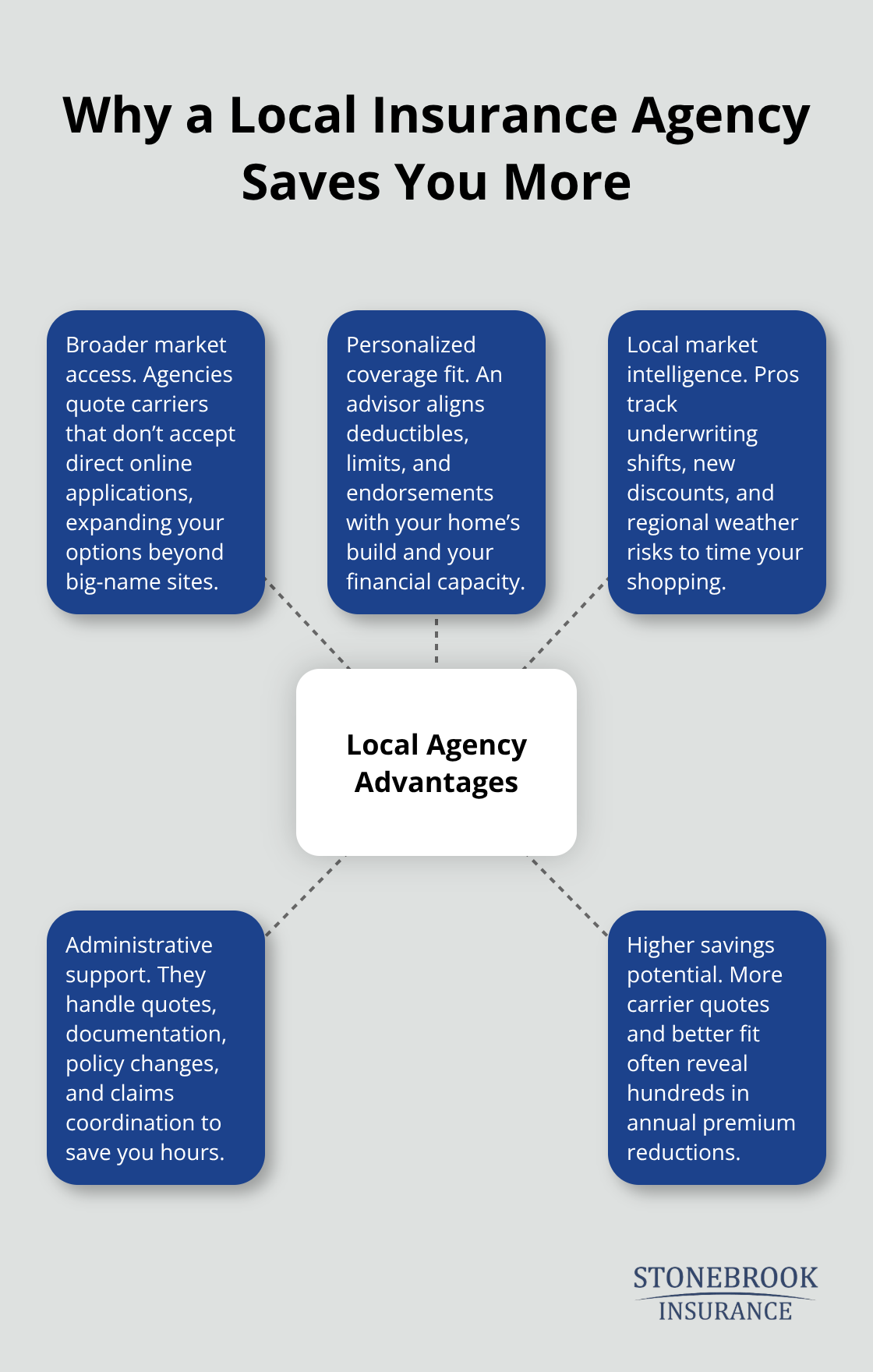
Local insurance agencies access carriers that don’t accept direct online applications. When you shop independently, you’re limited to companies that advertise heavily and maintain user-friendly websites. You miss the regional specialists and smaller carriers that often offer better rates for specific situations. Most homeowners who shop alone compare three to four carriers, while a local agency routinely evaluates eight to twelve options for a single client. The difference translates to real money-homeowners frequently discover savings of $300 to $600 annually that they never would have found alone because the best rate doesn’t always come from the company with the biggest advertising budget.
Access to Multiple Major Carriers Reveals Hidden Options
Shopping independently limits your options to carriers with strong online presence. A local agency pulls quotes from companies that specialize in older homes, high-value properties, and coastal Texas risks. These carriers often offer better rates for specific situations than the mainstream options you find through a web search. One homeowner might qualify for a discount with a carrier that doesn’t advertise online, while another finds their best rate with a regional specialist. The carriers you access through a local agency (rather than direct online) frequently offer competitive pricing that major online platforms simply don’t show. This expanded access matters because carrier appetites shift constantly-what works best today might change next year as companies adjust their underwriting standards.
Personalized Coverage Recommendations Prevent Costly Mistakes
Generic online quote tools ask standardized questions and produce one-size-fits-all recommendations. Your home’s actual risk profile is far more nuanced. A 1970s brick home in McKinney faces different weather risks than a 2015 custom build in Round Rock, yet both might receive identical coverage suggestions from automated systems. A local agency examines your home’s specific construction, your claims history, your financial capacity to absorb a deductible, and your actual replacement cost-not an algorithm’s estimate. Many Texas homeowners carry either too much coverage they don’t need or too little to actually rebuild. These aren’t theoretical adjustments-they’re concrete changes that prevent either underinsurance disasters or overpaying for redundant protection.
Local Expertise Tracks Market Shifts and Regional Variations
Insurance rates and carrier appetites shift constantly, and what worked last year might not work today. A roof that’s acceptable to one carrier in Central Texas might trigger rate increases with another. Hail-prone areas command different underwriting standards than regions with minimal weather risk. A local agency tracks when carriers tighten or loosen their underwriting, when they introduce new discounts, and when they exit markets or adjust pricing. This local intelligence prevents you from wasting time with carriers who’ve recently decided your neighborhood is too risky. A local agency also handles the administrative work that most people dread-gathering documentation, requesting additional quotes when rates shift, managing policy changes, and handling claims coordination. The time you save by not managing this yourself has actual value, especially when combined with the premium reductions a local agency identifies.
Final Thoughts
Texas homeowners can reduce what they pay for coverage through concrete actions. Bundling policies saves 15% to 25% annually, while security features like monitored alarm systems cut premiums by 5% to 15%. Claims-free records reward you with 5% to 10% discounts, and raising your deductible from $500 to $1,000 typically drops your premium by 15% to 25%. Upgrading your roof or electrical wiring signals lower risk to underwriters and qualifies you for additional savings, while shopping multiple carriers reveals pricing gaps that often exceed $300 to $400 per year.
The real action starts with comparing quotes from different insurers since most homeowners who shop independently evaluate only three to four carriers and miss better options. You should request quotes every two to three years because carrier appetites and your risk profile both change over time. Calculate whether raising your deductible makes financial sense based on your actual emergency savings, review your home’s physical condition to identify upgrades that address regional hazards like hail or wind damage, and confirm which homeowners insurance discounts Texas carriers offer before deciding whether to switch.
A local agency changes the equation by accessing carriers that don’t accept direct online applications, giving you eight to twelve options instead of three or four. We at Stonebrook Insurance evaluate your specific situation rather than relying on automated recommendations that miss important details about your home and financial capacity, and we track when carriers shift their underwriting standards and when new discounts become available. Contact Stonebrook Insurance to explore your savings options with a team that handles the administrative work most people avoid.
The information provided in this blog is for general informational purposes only and does not constitute legal, financial, or insurance advice. Coverage options, terms, and availability may vary. Please consult with a licensed professional for advice specific to your situation.
Artificial intelligence may have been used to generate text and images in some blog articles.