

Texas homeowners face rising insurance costs, and understanding what drives your premium home insurance rates is the first step toward smarter coverage decisions.
At Stonebrook Insurance, we’ve helped countless Texans navigate their options and find policies that actually fit their needs and budgets. This guide breaks down the factors affecting your rates, the coverage options available, and practical ways to reduce what you’re paying.
What Drives Your Texas Home Insurance Premium
Location and Weather Risk Shape Your Baseline Rate
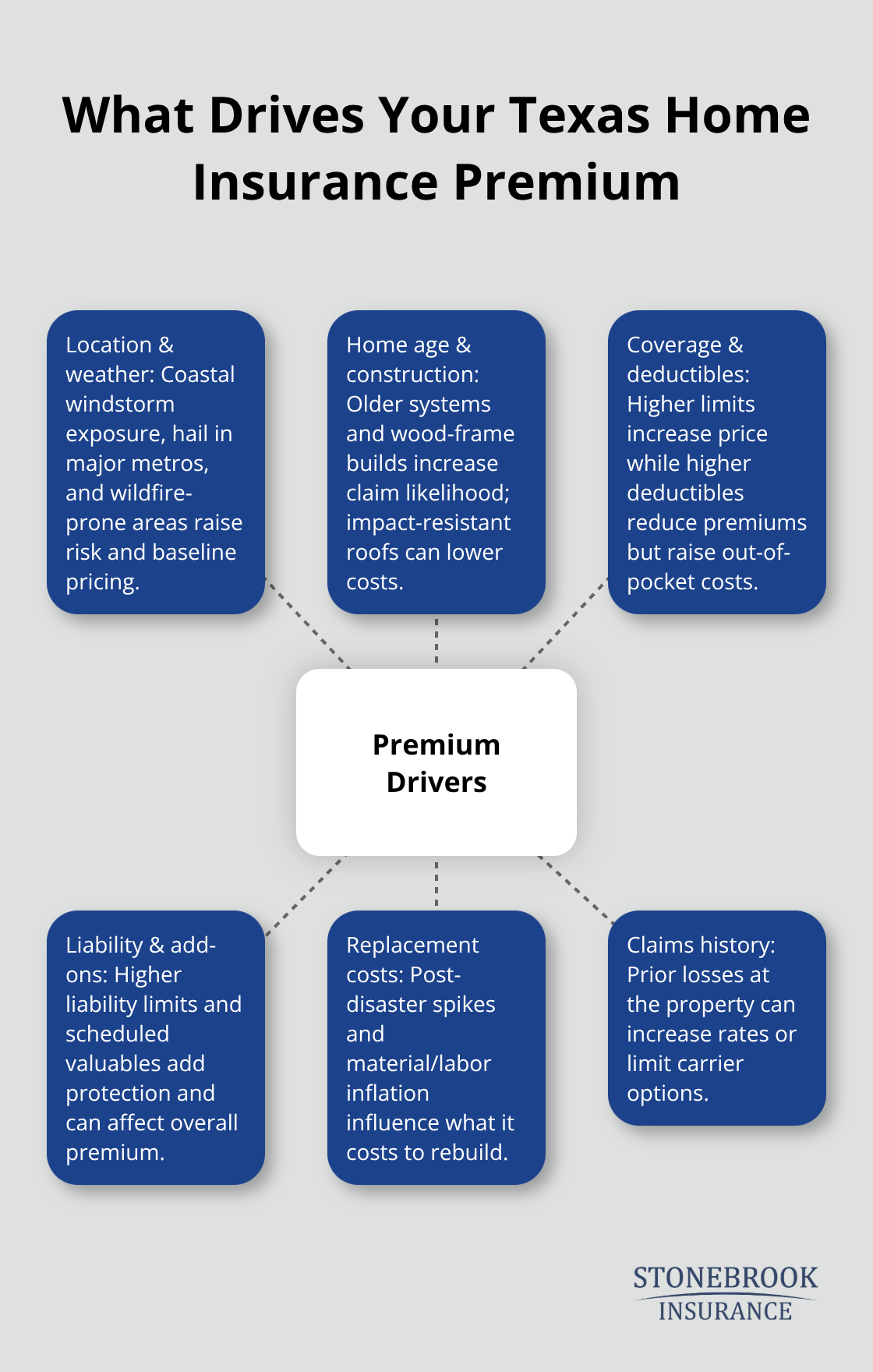
Your location within Texas matters far more than most homeowners realize. The Texas Department of Insurance reports that coastal and windstorm-prone areas pay significantly higher premiums due to hurricane exposure. If you live in counties designated as coastal, you’re looking at additional windstorm coverage requirements that add to your annual costs. Inland regions like Austin, Dallas, and San Antonio face different risks-hail damage occurs frequently enough that insurers price it into every quote. Areas prone to wildfires, particularly in Central and West Texas, also see premium increases because replacement costs spike during fire seasons. Your zip code essentially determines your baseline rate before any other factors enter the equation.
Home Age and Construction Type Affect Claim Risk
Home’s age and construction type work together to shape what insurers charge. Homes built before 1978 with outdated electrical, plumbing, or roofing systems face higher premiums because claim frequency increases with age-related failures. A home built in 2010 versus 2000 can show a noticeable rate difference. Construction matters too-a wood-frame house costs more to insure than a concrete block structure because wood burns faster and sustains water damage more easily. Roof age directly correlates with claim risk, so older roofs increase your premium. Upgrading to impact-resistant roofing, which withstands hail better, can actually lower your premium despite the upfront cost.
Coverage Limits and Deductibles Set Your Price Point
Your choice of dwelling coverage limits and deductibles creates the widest range in what you pay. A homeowner selecting $250,000 in dwelling coverage on a $400,000 home is underinsured and faces a lower premium but catastrophic financial risk. The correct approach involves calculating replacement cost, not market value-what it actually costs to rebuild your home today, not what it would sell for. Deductibles operate as your financial commitment; choosing a $2,500 deductible instead of $500 reduces your annual premium by roughly 15-25%, but you absorb that cost when a claim happens.
Liability and Additional Coverage Expand Your Protection
Liability coverage limits also swing your rate significantly. Standard policies offer $100,000 in liability protection, but Texas homeowners with substantial assets should carry $300,000 or higher to match their actual exposure. Additional living expenses coverage, which pays your hotel and meal costs if your home becomes uninhabitable, adds modest cost but protects your cash flow during reconstruction. Specialty coverage for high-value homes, jewelry, or collections requires separate scheduling because standard homeowners policies cap coverage on individual items. A $15,000 engagement ring might only receive $2,500 protection under a basic policy, so scheduled personal property coverage becomes necessary for valuable items.
Understanding these rate drivers positions you to make informed decisions about your coverage. Learn more about home insurance options available to Texas homeowners and how each one protects your financial interests.
What Coverage Do Texas Homeowners Actually Need
Dwelling Coverage Protects Your Home’s Reconstruction
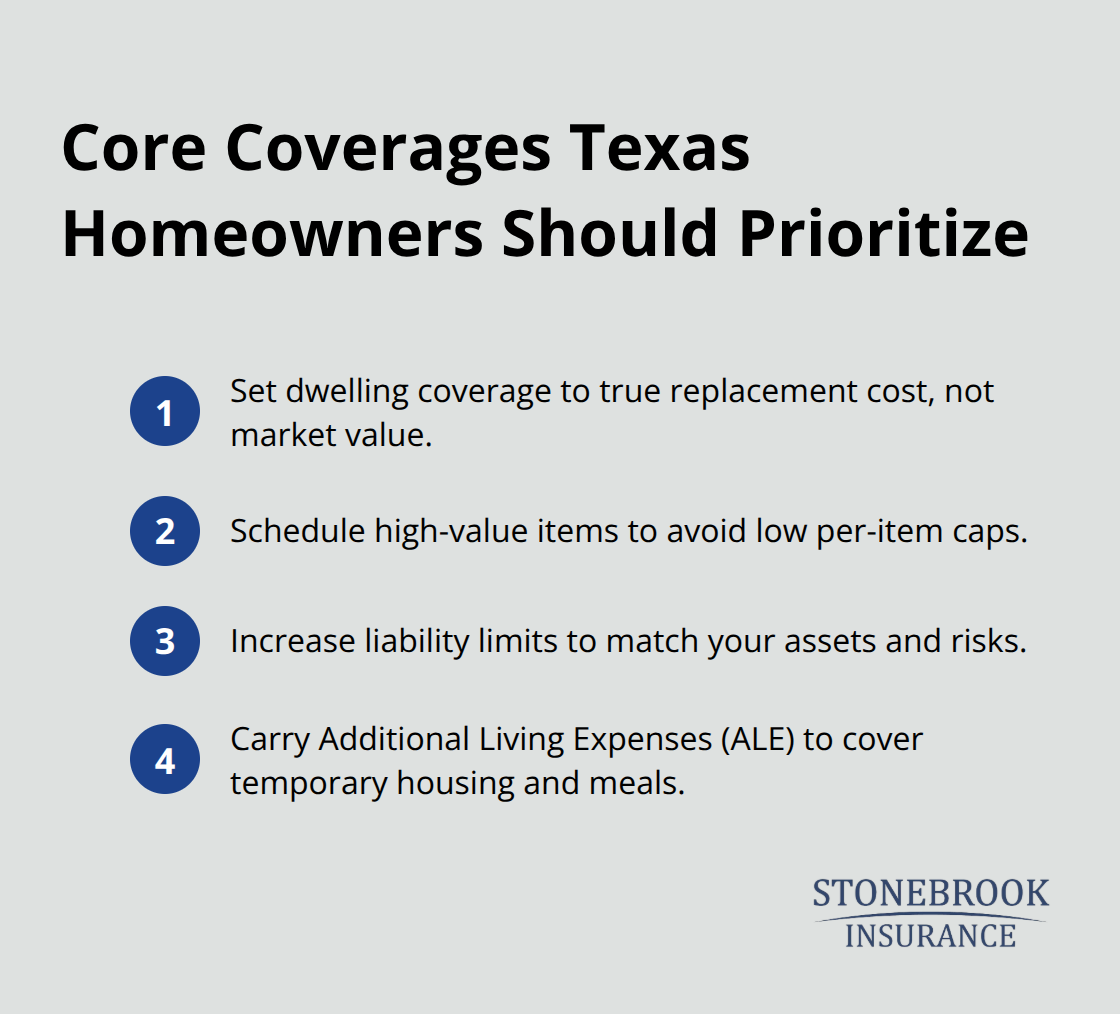
Dwelling coverage forms the foundation of your homeowners policy, and selecting the correct amount prevents financial catastrophe. This coverage pays to rebuild your home if it’s damaged or destroyed, calculated based on replacement cost rather than market value. The Texas Department of Insurance reports that underinsurance affects many homeowners, with coverage limits running 20-30% below actual replacement costs. If your home would cost $450,000 to rebuild today and you carry only $300,000 in dwelling coverage, you absorb the $150,000 gap yourself. A professional replacement cost estimate from a contractor should guide your dwelling limit selection, not your home’s sale price or tax assessment.
This step takes a few hours but protects you from catastrophic losses.
Personal Property Coverage Protects Your Belongings
Personal property coverage protects your belongings inside your home, typically covering 50-70% of your dwelling limit automatically. A $300,000 dwelling limit provides roughly $150,000-$210,000 for furniture, electronics, clothing, and other possessions. Most standard policies cap individual items at $2,500 for jewelry and $5,000 for firearms, which leaves valuable collections dangerously exposed without additional scheduling. High-value items require scheduled personal property coverage, which lists items individually with agreed values. Without scheduling, you’re limited to the standard $2,500-$5,000 caps per category, leaving thousands in potential losses unprotected.
Liability Coverage Shields You from Lawsuit Costs
Liability coverage protects you when someone is injured on your property and sues for damages. Standard homeowners policies include $100,000 in liability protection, but this amount hasn’t kept pace with actual lawsuit costs in Texas. A serious injury claim resulting in permanent disability can easily exceed $500,000, and jury verdicts can run into the millions. The Insurance Information Institute reports that liability claims have grown substantially over the past decade, making higher limits prudent for most homeowners. Carrying at least $300,000 in liability coverage makes sense for most Texas homeowners, and $500,000 if you have a pool, trampoline, or frequently host gatherings.
Additional Living Expenses and Specialty Coverage
Additional living expenses coverage pays your hotel, restaurant meals, and other costs if your home becomes uninhabitable after a covered loss. This coverage typically adds only $20-$40 annually but prevents financial strain during reconstruction. High-value homes require specialty coverage because standard policies impose strict limits on expensive items. Artwork valued at $50,000, jewelry collections, and antiques need scheduled personal property coverage to receive full protection. Without these additions, you face significant gaps between what your policy covers and what you actually need to replace.
The coverage options available to you create a foundation for financial protection, but the real challenge lies in identifying which discounts and adjustments can lower what you actually pay for that protection.
How to Cut Your Texas Home Insurance Costs
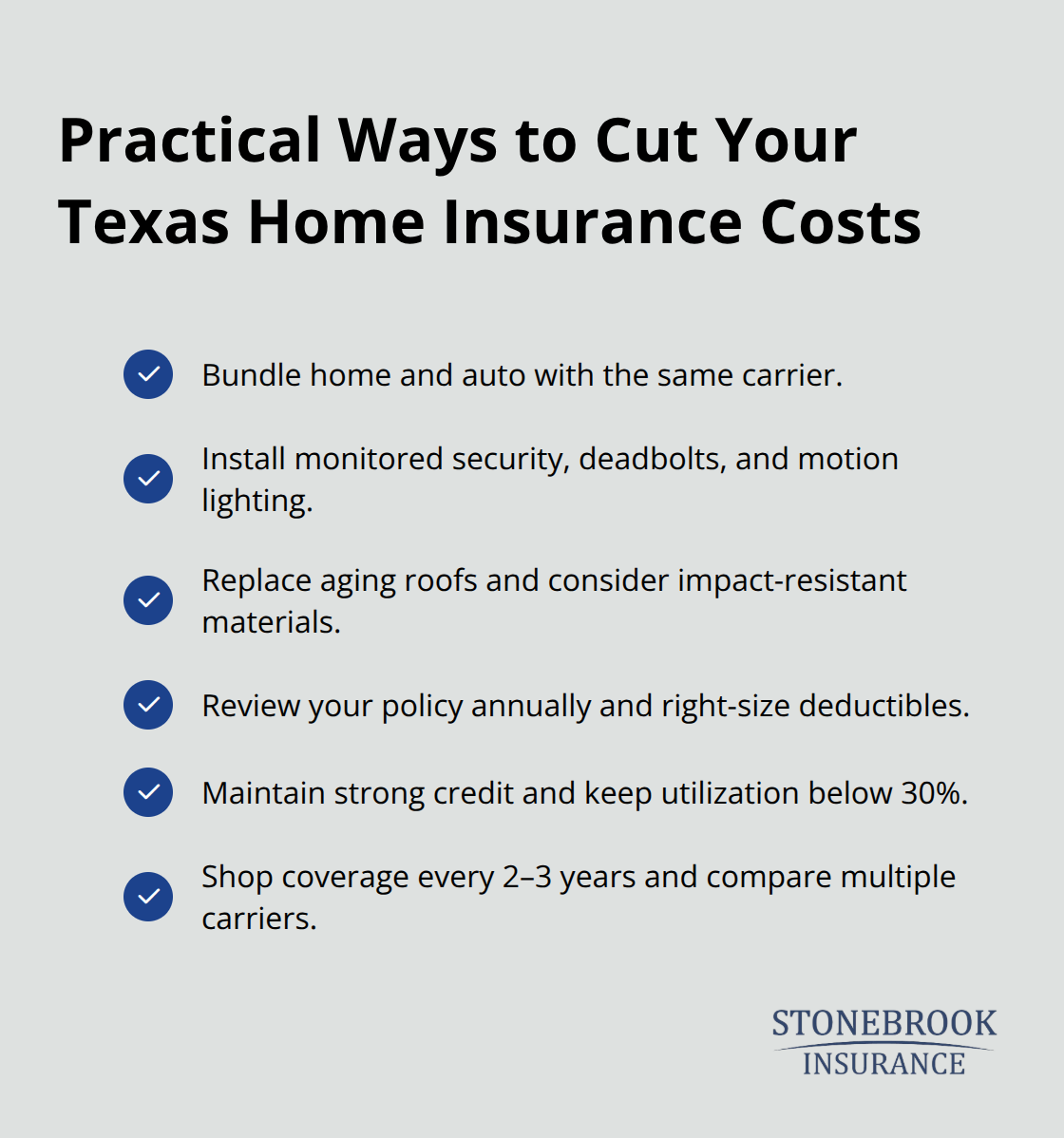
Lowering your premium requires moving beyond passive acceptance of whatever rate your insurer quotes. Homeowners leave hundreds of dollars annually on the table by ignoring concrete savings opportunities. Bundling your home and auto policies with the same carrier can save you money on your combined premiums, yet many Texas homeowners maintain separate policies with different companies. Before accepting any quote, request bundling discounts explicitly and compare the total cost across multiple carriers rather than evaluating policies in isolation.
Security Upgrades Reduce Your Premium Measurably
Security upgrades deliver measurable savings that compound over years. Installing deadbolt locks, motion-sensor exterior lighting, and monitored alarm systems reduces your premium by 5-15% because insurers recognize these features lower claim frequency. A professionally monitored system typically costs $30-$50 monthly but can reduce your annual insurance cost by $150-$300, creating net savings within the first year.
Roof Condition Shapes Your Rate Significantly
Roof condition dominates the underwriting decision for Texas homes, so replacing an aging roof before shopping for new coverage prevents rate penalties that would persist for years. The Texas Department of Insurance data shows homes with roofs over 20 years old face substantially higher premiums, sometimes 20-30% above comparable homes with newer roofs.
Annual Reviews Catch Coverage Gaps
Annual policy reviews catch coverage gaps and outdated limits that inflate your costs unnecessarily. Most homeowners set their coverage once and never revisit it, missing opportunities to adjust deductibles as their financial situation improves or reduce dwelling coverage if they’ve paid down their mortgage significantly. Increasing your deductible from $500 to $1,500 typically cuts premiums by 15-20%, assuming you have adequate emergency savings to cover the higher out-of-pocket cost when claims occur.
Removing duplicate coverage matters too-if you’ve paid off your mortgage, you can eliminate the mortgage lender’s required coverage and potentially adjust your dwelling limit downward if your home’s replacement cost has decreased.
Credit Score and Shopping Frequency Impact Your Rate
Maintaining a good credit score affects your insurance rate substantially, with insurers viewing financial responsibility as a proxy for claim likelihood. Paying bills on time and keeping credit utilization below 30% can lower your premium by 10-25% depending on your current score. Shopping every 2-3 years prevents rate creep, where your insurer gradually increases your premium while competitors offer better pricing on identical coverage. The Insurance Information Institute reports that homeowners who shop only once or twice in their lifetime pay 20-40% more than those who shop regularly.
Final Thoughts
Premium home insurance in Texas requires you to balance adequate protection with manageable costs, and the decisions you make today determine your financial security for years ahead. Your location, home characteristics, and coverage choices create your baseline rate, but you control whether you shop for better pricing or accept whatever your current insurer quotes. Shopping every few years, upgrading security features, and maintaining a solid credit score deliver measurable savings that accumulate substantially over time.
Rates vary significantly between insurers for identical homes and coverage levels, so comparing quotes across multiple carriers pays immediate dividends. A homeowner who spends two hours gathering quotes might uncover $300–$500 in annual savings, which translates to thousands over a decade. Working with a local agent transforms the insurance process from frustrating paperwork into a partnership focused on your actual needs and financial interests.
We at Stonebrook Insurance shop multiple major carriers to find you competitive pricing on premium home insurance Texas homeowners depend on, and we handle the details so you don’t navigate policy language alone. With three locations across Texas in Comanche, McKinney, and Round Rock, we provide hands-on service backed by deep knowledge of Texas-specific risks and coverage requirements. Contact Stonebrook Insurance to discuss your coverage needs and see how personalized service delivers both protection and savings.
The information provided in this blog is for general informational purposes only and does not constitute legal, financial, or insurance advice. Coverage options, terms, and availability may vary. Please consult with a licensed professional for advice specific to your situation.
Artificial intelligence may have been used to generate text and images in some blog articles.