
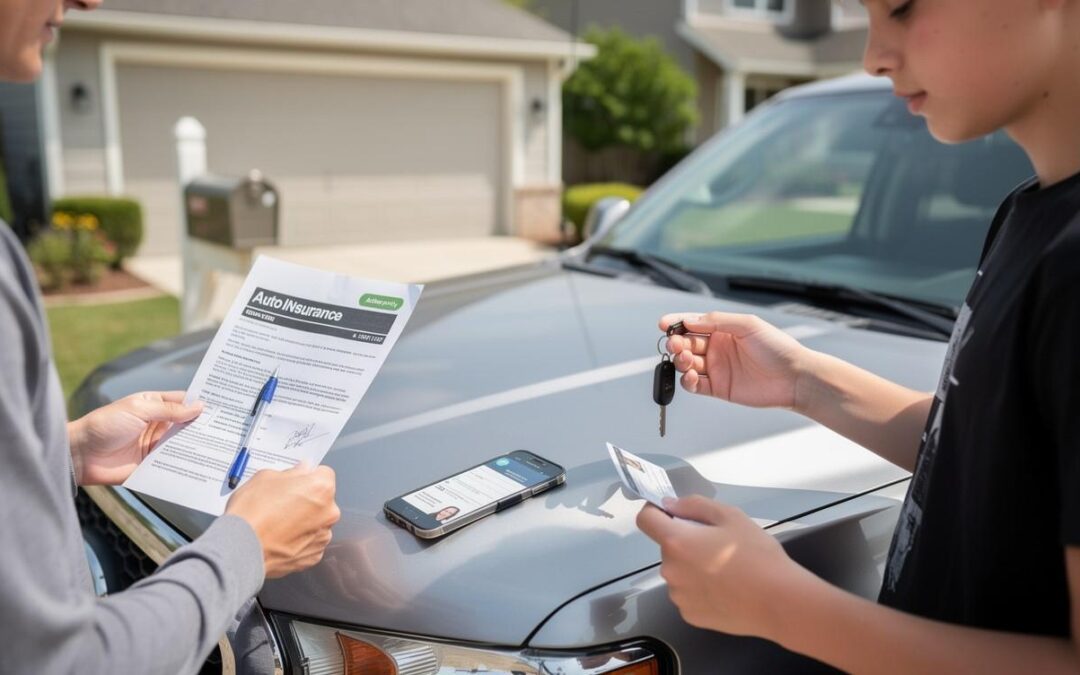
Adding a teen driver to your family’s auto insurance policy in Texas comes with sticker shock. At Stonebrook Insurance, we know parents and teens alike struggle to understand why teen auto insurance Texas rates are so high and what options exist to bring costs down.
This guide breaks down the real reasons behind those premiums, practical ways to reduce them, and what Texas law actually requires.
Why Teen Drivers Cost More to Insure
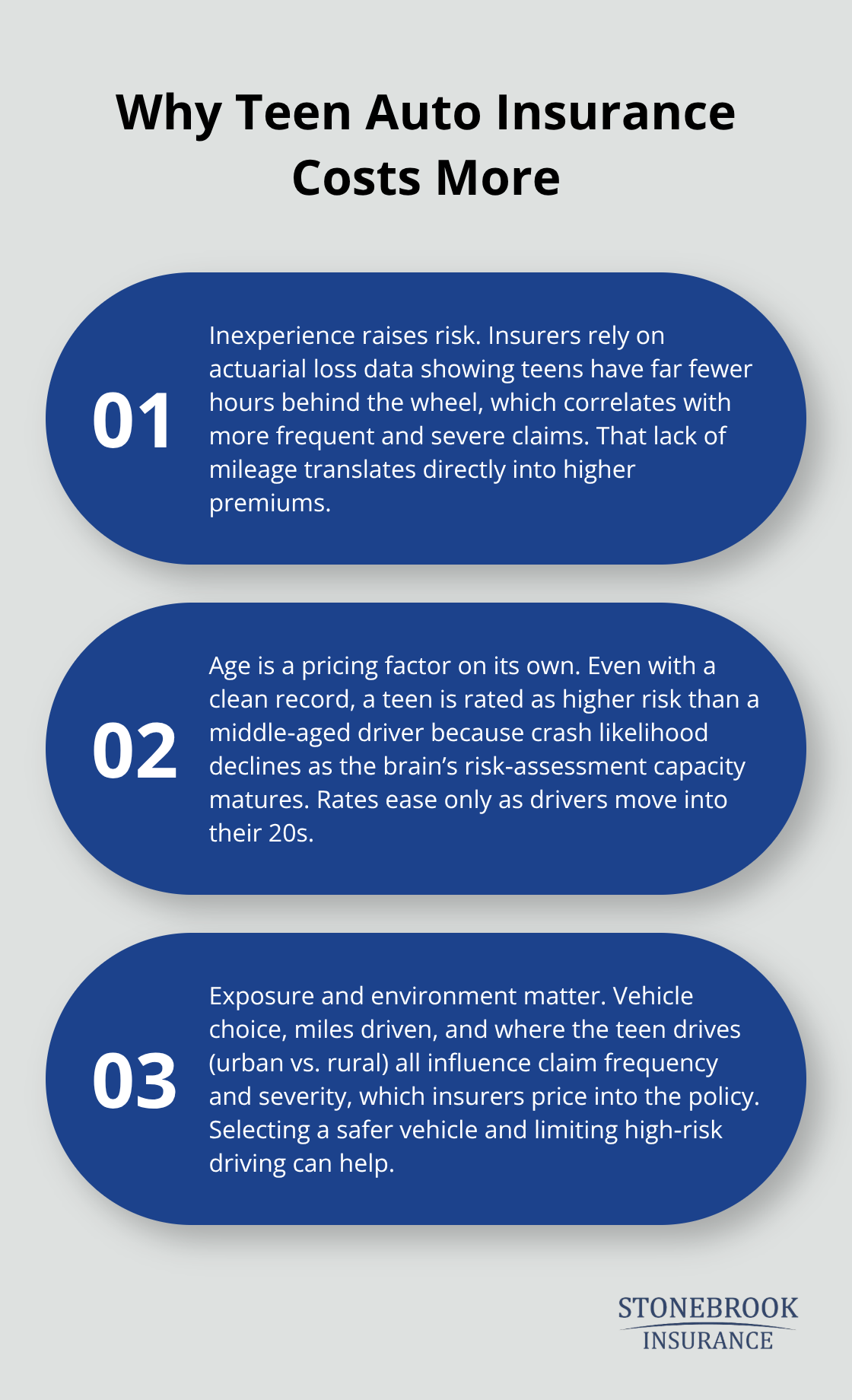
Teens face higher auto insurance premiums in Texas because they statistically cause more accidents. Teen drivers are three times more likely to crash than drivers aged 20 and older, according to the CDC. This isn’t about judgment-it’s raw data that insurers use to calculate risk. When an insurer quotes a teen driver, they’re pricing based on inexperience, not personality. A teen with a perfect driving record still pays more than a 40-year-old with a similar record because age itself is a risk factor.
Age and Inexperience Drive the Numbers
The jump in premiums happens the moment a teen obtains a license. A 16-year-old paying their own way might see quotes above $3,000 annually for basic coverage, while adding that same teen to a parent’s policy typically costs $1,500 to $2,500 per year in additional premiums. The difference reflects that teen drivers lack the thousands of hours of experience that reduce risk over time. Insurers track loss data by age group, and teens consistently show higher claim frequency and severity. This data comes from actuarial studies that insurers use to set rates. The premium gap narrows slightly as teens move into their 20s, but it doesn’t disappear until around age 25 when the brain’s risk-assessment areas fully mature.
How Violations and Accidents Multiply Costs
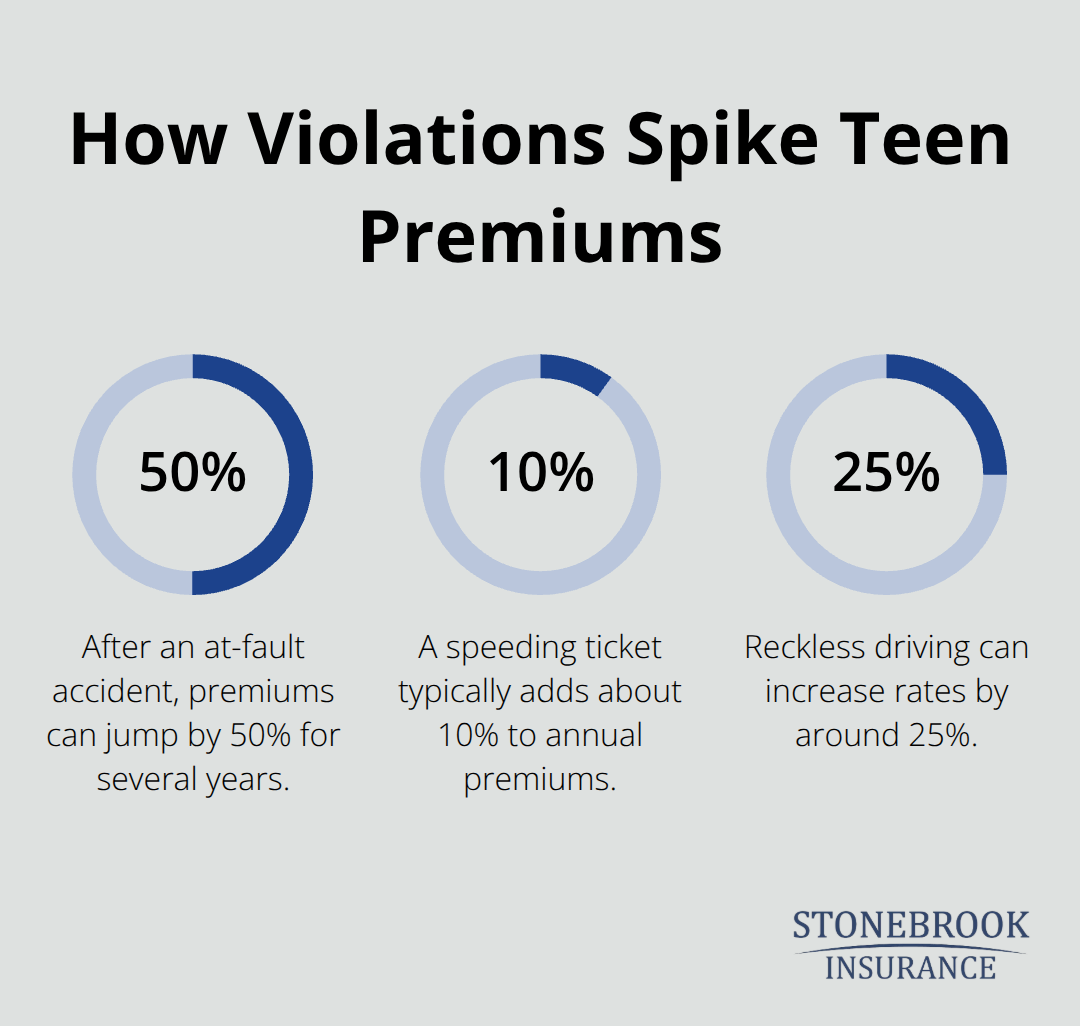
A single accident or traffic violation transforms a teen’s insurance situation dramatically. A teen driver involved in an at-fault accident might see premiums jump 50% to 100% for three to five years, depending on the insurer and the severity of the crash. A speeding ticket adds 10% to 15% to annual premiums, while reckless driving charges can increase rates by 25% or more. These increases compound because insurers view violations as predictors of future claims. A teen with one accident is statistically more likely to have another, so insurers price accordingly.
In Texas, moving violations stay on a driving record for three years, meaning a teen who receives a ticket at 16 carries that cost impact through age 19. A clean driving record becomes the most valuable asset a teen can build for insurance costs.
Texas Insurance Rates and Risk Factors
Texas insurers apply statistics consistently across the state, which means your teen’s premium reflects statewide accident patterns, not just local conditions. Location within Texas does matter-urban areas typically carry higher rates than rural regions because accident frequency increases in dense traffic. Vehicle type also influences the quote; a sports car or high-performance vehicle costs more to insure than a sedan or SUV. The insurer evaluates your teen’s specific situation (age, driving history, vehicle choice, and miles driven) to arrive at a final rate. Understanding these factors helps parents and teens make informed decisions about coverage options and potential cost reductions.
Ways to Cut Teen Auto Insurance Costs
Good Student Discounts and Safety Features
A teen maintaining a 3.0 GPA or higher qualifies for a discount on auto insurance premiums, according to data from major insurers. Most carriers accept 3.0 as the threshold, though some require 3.5, so parents should ask insurers directly about their specific GPA requirements. The discount applies as long as the teen maintains the grade requirement, creating ongoing incentive for academic performance.
Safety features matter equally to insurers when calculating risk. Installing anti-theft devices, electronic stability control, and forward-collision warning systems can reduce premiums by 5% to 10%. A teen driver in a vehicle with these systems presents lower risk to an insurer, and that lower risk translates to lower rates. Parents should review what safety features their vehicle already has before purchasing a teen’s car, as this directly impacts insurance costs.
Bundling Policies and Defensive Driving Courses
Bundling your auto policy with homeowners or renters insurance at the same carrier typically delivers 15% to 25% in combined savings across all policies. If a parent insures a teen on the family auto policy while also holding a homeowners policy with the same insurer, that household saves substantially compared to splitting coverage across multiple companies.
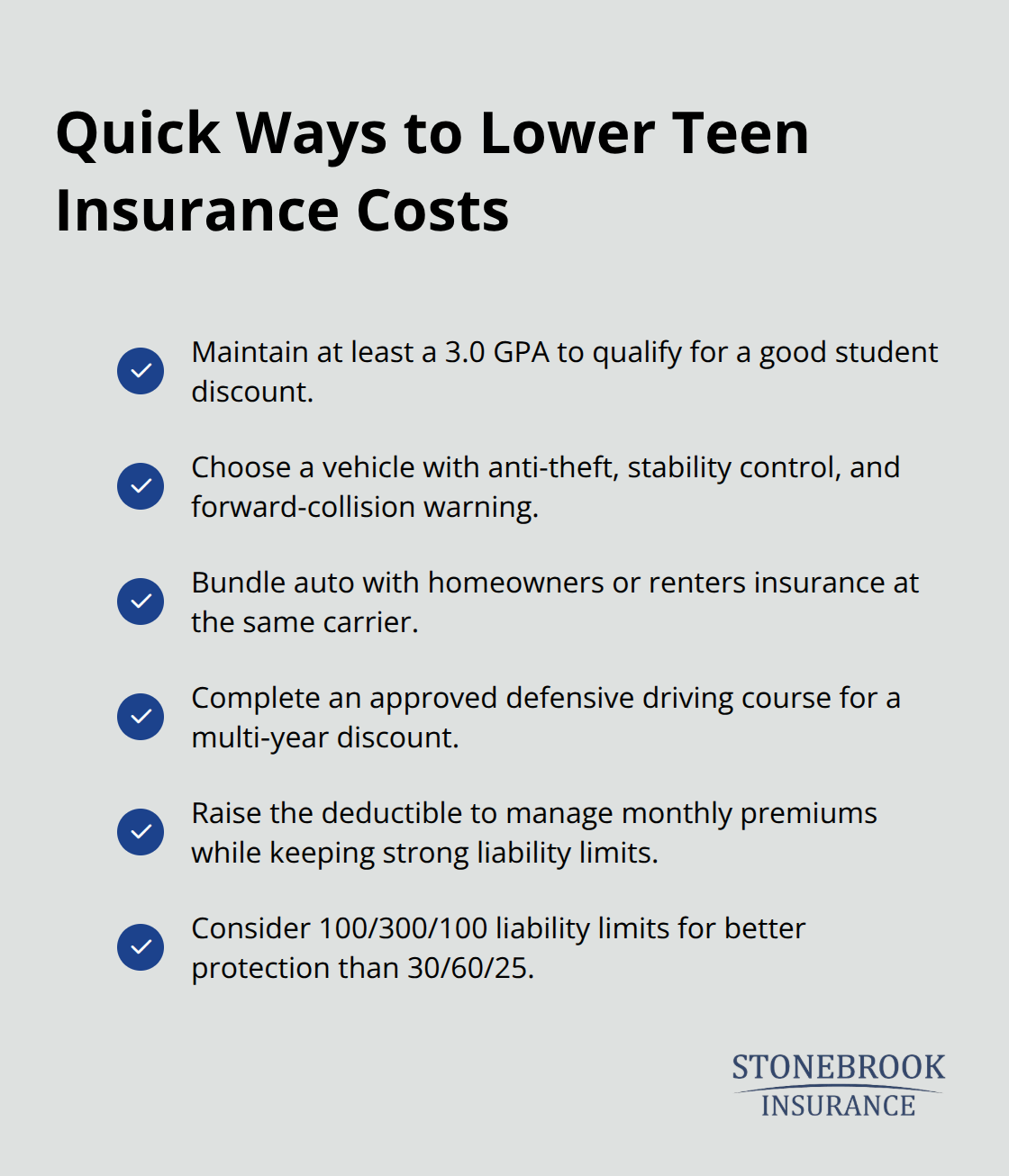
Defensive driving courses offer another concrete reduction. A teen completing an approved defensive driving program through organizations like the National Safety Council qualifies for a 5% to 10% discount that can last three years or more, depending on your insurer. Texas recognizes defensive driving certification, and some courses can be completed online in as little as four hours. The cost of the course typically runs $20 to $50, making it one of the cheapest ways to reduce premiums.
Choosing the Right Coverage Limits
Parents often make the mistake of choosing minimum liability coverage to save money upfront. Texas requires 30/60/25 liability coverage at minimum (30,000 per person for bodily injury, 60,000 per accident, 25,000 for property damage), but a teen involved in a serious accident easily exceeds these limits. Increasing to 100/300/100 coverage costs roughly 10% to 15% more annually but protects your family from catastrophic liability claims. A single accident injury claim can reach six figures; minimum coverage leaves you exposed.
For a teen driver, prioritize adequate liability limits over low deductibles. A $1,000 deductible costs more upfront than a $500 deductible, but if your teen causes an accident, you’ll face that deductible amount out of pocket. Most families can absorb a $1,000 deductible but struggle with ongoing premium costs, so raising the deductible while maintaining strong liability coverage makes financial sense. Understanding these coverage choices positions you to make decisions that protect both your finances and your teen’s future on Texas roads.
What Texas Actually Requires from Teen Drivers
Texas law mandates that every driver carry minimum liability insurance before operating a vehicle on public roads. The state’s minimum coverage is 30/60/25, meaning $30,000 in bodily injury liability per person, $60,000 per accident, and $25,000 in property damage liability. These numbers sound substantial until you consider what a single serious accident costs. A teen causing a multi-car collision on Interstate 35 could easily generate medical bills exceeding $200,000. If your teen hits another vehicle and injures the driver and passenger, the $30,000 per-person limit evaporates in minutes. Texas doesn’t allow you to satisfy this requirement through self-insurance unless you’re a large fleet operator or government entity, so your teen needs an active policy from a licensed insurer before driving.
State Minimum Coverage Laws
The 30/60/25 standard reflects Texas’s approach to financial protection, but it falls short in real-world accidents. Most serious injury claims exceed $30,000 per person. A teen driver at fault in a crash involving multiple vehicles or severe injuries will quickly exhaust minimum limits. Courts then look to your personal assets to cover the difference. This is why understanding the minimum requirement matters-it shows you what the law allows, not what actually protects your family. Increasing coverage to 100/300/100 costs roughly 10% to 15% more annually but shields you from catastrophic liability exposure.
Liability Limits and Financial Responsibility
The financial responsibility law in Texas is unforgiving. If your teen causes an accident and lacks insurance, the state suspends their license immediately and indefinitely until proof of financial responsibility is filed. That proof requires filing an SR-22 form, which signals to the state that you maintain continuous coverage. A suspended license at age 16 derails a teen’s independence and creates a permanent mark on their driving record. The penalties escalate from there: driving without insurance in Texas carries fines up to $1,000, potential jail time up to 180 days, and mandatory community service. Repeat violations compound these consequences.
Personal Liability and Asset Protection
If your teen causes an accident without insurance, you face personal liability for damages that exceed your policy limits or any assets you own. Texas courts can garnish wages and seize property to satisfy judgments. A single serious accident can result in six-figure liability claims that far exceed the savings from choosing minimum coverage. Choosing minimum coverage to save $200 annually exposes your household to catastrophic financial loss. Adequate coverage protects your family’s finances from claims that could otherwise destroy your financial stability for years.
Final Thoughts
Teen auto insurance Texas rates reflect real risk, but you control several factors that directly lower your costs. A clean driving record, strong grades, defensive driving certification, and adequate coverage limits work together to protect your teen and your family’s finances. Shopping multiple insurers reveals significant rate differences-families typically save $300 to $500 annually by comparing quotes rather than accepting the first offer.
Finding the right coverage requires asking each insurer about available discounts, verifying their GPA thresholds, and confirming which safety features reduce premiums. Don’t assume your current carrier offers the best rate for a teen driver; rates vary substantially based on how each company evaluates young drivers. Adjusting your deductible and coverage limits to match your family’s actual needs further optimizes your protection without overpaying.
Contact Stonebrook Insurance to discuss your teen’s coverage options with a local agent who understands Texas insurance requirements and discount opportunities. Our team shops multiple carriers to secure rates tailored to your teen’s specific situation. Your teen’s safety and your family’s financial security depend on making this decision with expert guidance.
The information provided in this blog is for general informational purposes only and does not constitute legal, financial, or insurance advice. Coverage options, terms, and availability may vary. Please consult with a licensed professional for advice specific to your situation.
Artificial intelligence may have been used to generate text and images in some blog articles.