
Adding a teen driver to your car insurance policy in Texas means navigating coverage options that protect both your wallet and your teenager. The costs can feel overwhelming, but understanding what’s actually included in modern policies makes the decision much simpler.
At Stonebrook Insurance, we’ve helped countless Texas families find the right balance between comprehensive protection and affordable premiums. This guide breaks down exactly what teen driver coverage Texas includes and how to keep costs manageable.
What Coverage Your Teen Driver Actually Needs
Liability Protection: The Legal Foundation
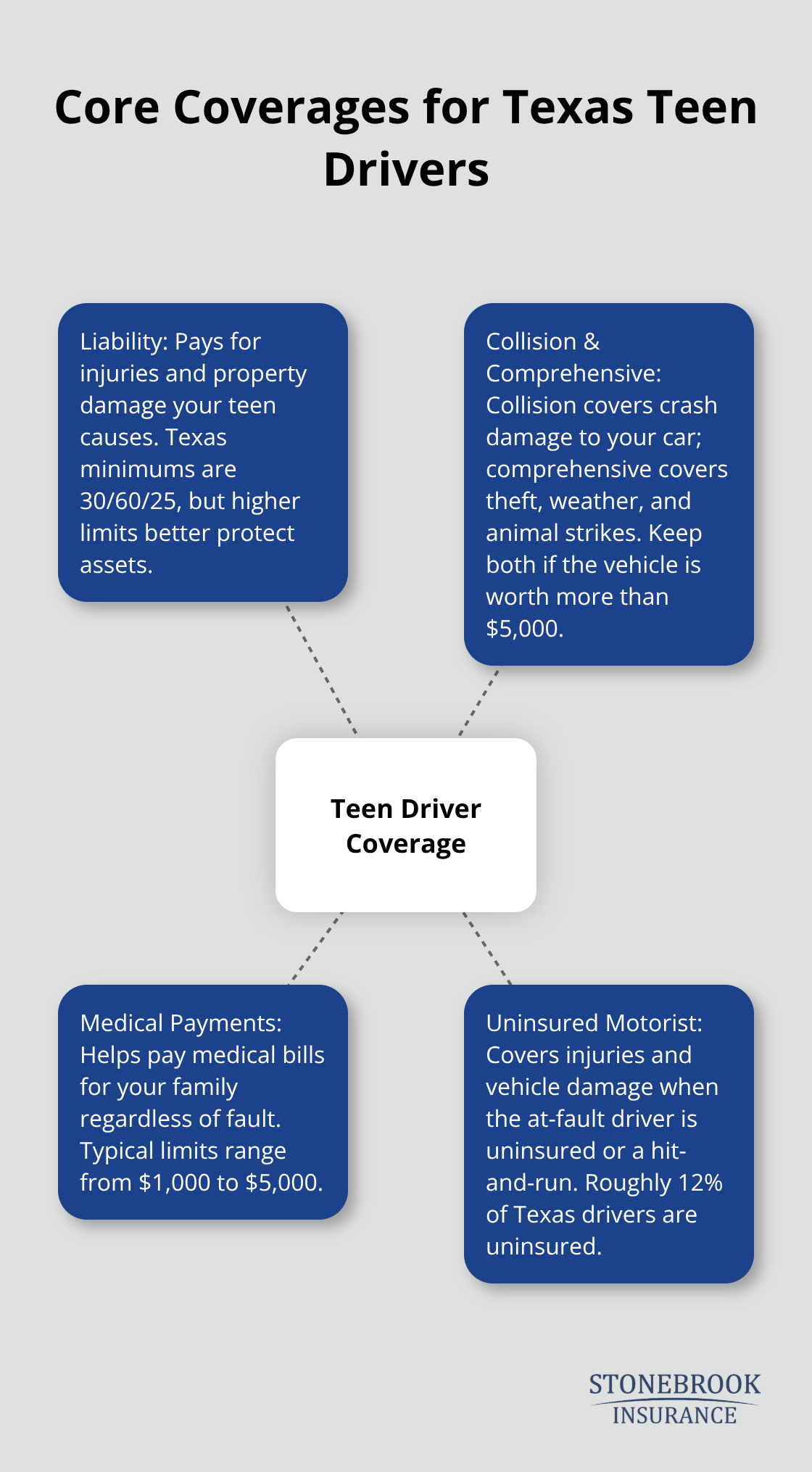
Texas law requires liability coverage on every vehicle, and that’s the foundation of teen driver protection. Liability covers bodily injury and property damage when your teen causes an accident. Texas sets minimum liability limits at 30/60/25, meaning $30,000 per person for injuries, $60,000 total per accident for injuries, and $25,000 for property damage.
These minimums are dangerously low. The average car accident costs around $7,700 in medical expenses alone, according to data from the National Highway Traffic Safety Administration. A single serious accident can exceed Texas’s minimum limits, leaving your family financially exposed. You should carry at least 100/300/100 limits for any household with a teen driver.
This modest increase in premium typically costs $15 to $25 monthly but protects your assets if your teen causes major injuries or damage.
Collision and Comprehensive: Protecting the Vehicle
Collision and comprehensive coverage protects the vehicle itself, not just liability. Collision covers damage from crashes with other vehicles or objects, while comprehensive handles theft, weather, and animal strikes. Most lenders require both if you’re financing a car, but many parents drop these when a vehicle is paid off.
That’s a mistake with teen drivers. Teens aged 16 to 19 have higher crash rates than drivers aged 20 and older. If your teen drives a vehicle worth more than $5,000, collision and comprehensive are worth keeping. The cost of repairs often justifies the coverage, especially when you factor in your teen’s inexperience behind the wheel.
Medical Payments and Uninsured Motorist Coverage
Medical payments coverage is often overlooked but pays your family’s medical bills regardless of fault, up to your policy limit (typically $1,000 to $5,000). This coverage protects you even when your teen isn’t responsible for the accident. Uninsured motorist protection covers you if an uninsured or hit-and-run driver causes the accident.
Texas doesn’t require this coverage, but roughly 12% of Texas drivers are uninsured. Adding uninsured motorist protection costs minimal premium increases and covers medical expenses and vehicle damage when the other driver lacks insurance. These two coverages work together to fill gaps that liability alone cannot address. With the right combination of these protections in place, you can focus on the next critical step: finding ways to reduce what you pay for teen driver coverage.
Why Teen Drivers Cost More to Insure
The Statistics Behind Higher Premiums
Drivers aged 16 to 19 crash at rates nearly three times higher than drivers aged 20 and older. This isn’t a minor risk factor-it’s the primary reason insurance companies charge substantially more for teen drivers and why Texas law requires specific coverage. For every mile driven, teens face a higher probability of collision, which directly translates to higher claims payouts for insurers. When you add a teen to your policy, your premium increases by 50 to 100 percent depending on the vehicle and coverage levels. This dramatic increase reflects actual risk, not arbitrary pricing.
The number 100% seems to be not appropriate for this chart. Please use a different chart type.
Why Teen Drivers Lack Critical Skills
The National Highway Traffic Safety Administration reports that inexperienced drivers lack the judgment and reaction time to handle emergency situations on Texas roads. They misjudge speed, fail to detect hazards early, and panic under pressure. Specialized teen driver coverage exists because standard policies don’t account for these behavioral patterns. Insurance companies have decades of claims data showing exactly where teen drivers fail-distraction, speeding, and poor decision-making in challenging conditions top the list.
Texas Legal Requirements Leave Families Exposed
Texas minimums of 30/60/25 are legally sufficient but financially dangerous for households with teen drivers. A single serious accident involving a teen can generate medical bills exceeding $50,000, far beyond state minimums. Your family’s assets become vulnerable if your teen causes major injuries. Beyond liability, teens need collision and comprehensive coverage because they statistically use those protections more often than experienced drivers.
Uninsured Motorists Add Another Layer of Risk
Uninsured motorist coverage matters in Texas specifically because roughly 12 percent of drivers operate without insurance, and teens lack the experience to avoid uninsured motorists. This coverage protects your family when an uninsured or hit-and-run driver causes an accident. The specialized coverage approach isn’t overprotection-it’s calibrated protection based on how teen drivers actually perform on roads. Understanding these risk factors helps you make informed decisions about which coverage options protect your family most effectively.
How to Cut Teen Driver Insurance Costs Without Cutting Coverage
Good Student Discounts and Safety Courses Stack Fast
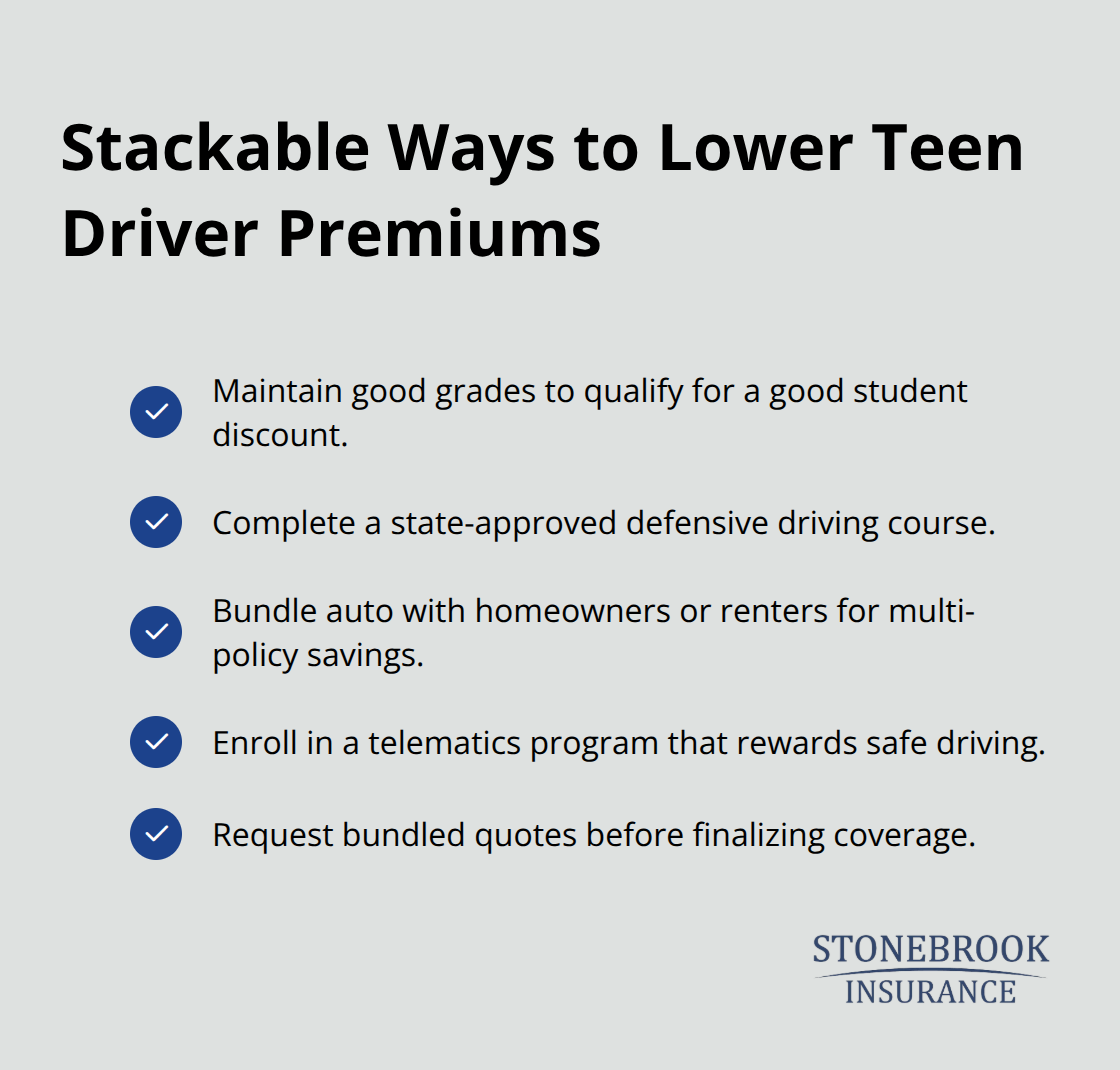
Good student discounts represent the fastest way to reduce premiums immediately. Insurance companies offer discounts for good student driver under age 25, according to data from the National Association of Insurance Commissioners. Completing a defensive driving course adds another discount with most insurers. The Insurance Institute for Highway Safety certifies specific courses, and many Texas high schools offer them free or at minimal cost. These discounts stack, meaning a teen with good grades and a completed safety course can reduce your premium increase compared to adding an unqualified driver.
Bundling Policies Cuts Your Total Insurance Costs
Combining your teen driver’s auto insurance with your homeowners or renters policy typically saves 15 to 25 percent on your total insurance costs. Most families reduce their overall insurance expenses by $600 to $1,200 annually through bundling. If you currently carry auto insurance with one company and homeowners with another, consolidating with a single carrier makes immediate financial sense when adding a teen driver. The savings compound because bundling discounts apply to your entire policy, not just the teen driver portion. Request quotes that bundle all your policies before making any decisions about teen driver coverage.
Telematics Programs Reward Safe Driving Behavior
Telematics apps and plug-in devices monitor your teen’s actual driving habits and offer discounts based on performance data. Programs like Allstate Drivewise, State Farm Drive Safe and Save, and similar offerings from most major carriers reduce premiums by 10 to 30 percent for safe drivers. These programs track speed, hard braking, acceleration, time of day driving, and miles driven. A teen who drives cautiously during daylight hours and avoids late-night driving qualifies for maximum discounts. Unlike hypothetical safety measures, telematics programs use real driving data to justify premium reductions, making them the most transparent discount available. If your teen drives responsibly behind the wheel, telematics programs transfer that responsible behavior directly into lower costs (most programs require no installation fee and provide your teen with immediate feedback on driving performance through smartphone apps).
Final Thoughts
Teen driver coverage in Texas requires you to balance legal compliance, financial protection, and affordability. Liability protection, collision and comprehensive options, medical payments, and uninsured motorist coverage form the foundation of responsible protection. Texas minimums satisfy legal requirements but leave your family financially exposed, so carrying higher liability limits and maintaining collision coverage on vehicles worth more than $5,000 creates a safety net that actually protects your assets when accidents happen.
Affordability doesn’t mean you sacrifice coverage. Good student discounts, defensive driving course credits, bundling policies, and telematics programs reduce your premium increase substantially without cutting protection. A teen with good grades enrolled in a safety course and using a telematics app can reduce the cost of teen driver coverage Texas by 30 to 50 percent compared to a teen driver without these discounts.
The right coverage strategy depends on your family’s specific situation-the vehicle your teen drives, your financial capacity to handle deductibles, and your teen’s driving habits. At Stonebrook Insurance, we work with Texas families to build teen driver coverage that matches their actual risk and budget. Contact us to review your teen driver coverage and identify savings you might be missing.
The information provided in this blog is for general informational purposes only and does not constitute legal, financial, or insurance advice. Coverage options, terms, and availability may vary. Please consult with a licensed professional for advice specific to your situation.
Artificial intelligence may have been used to generate text and images in some blog articles.